

|


|

This site
is mobile
responsive
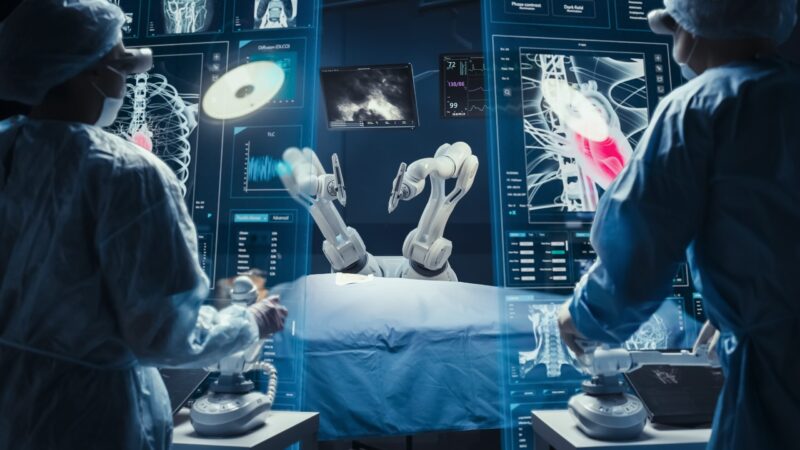
The global medical device industry is undergoing a profound transformation. It is moving rapidly beyond standalone hardware into an era defined by Artificial Intelligence (AI), digital health, automation, and hyper-connected healthcare ecosystems.
For forward-thinking investors and industry players, this evolution is reshaping the MedTech value chain. At the heart of transformation, Malaysia is strengthening its position as one of ASEAN’s leading manufacturing hubs, transitioning from a traditional ‘Build-to-Print’ manufacturer towards becoming a high-value, ‘Build-to-Design’ regional hub for next-generation medical technologies.
Artificial Intelligence (AI) is no longer an emerging concept; it is becoming the modern clinician’s co-pilot. Today, AI-powered solutions are increasingly integrated into:
These technologies help improve diagnostic accuracy, accelerate clinical decision-making, enhance operational efficiency, improve product quality and reduce production defects.
Crucially, the rapid expansion of AI data centres in Malaysia is creating strong synergies between the electrical & electronics (E&E) and medical devices industries. This convergence opens new opportunities for Malaysian innovators in:
Healthcare is rapidly shifting beyond hospitals through connected healthcare and remote patient monitoring solutions. Driven by global efforts to reduce hospital congestion and improve patient accessibility, demand for consumer healthcare electronics continues to grow.
The market is seeing strong demand for continuous glucose monitoring, cardiac tracking and respiratory care. This trend creates significant opportunities for Malaysian companies to develop end-to-end solutions in embedded systems, sensor technologies, Internet-of-Things (IoT) integration, cloud-based healthcare systems, and mobile healthcare applications.
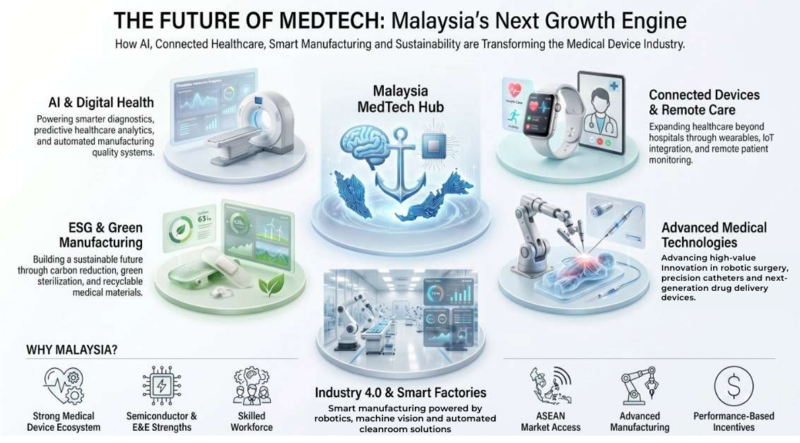
The global healthcare industry is increasingly moving towards minimally invasive procedures and advanced medical technologies. Growing demand for ultra-precise medical devices is driven by patients seeking faster recovery and health care providers aiming for shorter hospital stays.
This presents opportunities in smart surgical devices, precision catheters, advanced implants, robotic-assisted surgical systems, and next-generation drug delivery devices. Malaysia’s long-standing strengths in precision machining, advanced materials and manufacturing position local companies to produce medical-grade components and surgical subcomponents and offer high-value medical hardware.
As global regulatory requirements for safety and traceability become more stringent, manual manufacturing is steadily giving way to highly automated and precision-driven production environments.
Medical device manufacturers are following suit by adopting:
Malaysia’s strengths in industrial automation and precision engineering provide a solid foundation for local companies to support the growing demand for advanced manufacturing technologies within the medical device sector and smart factory solutions.

Environmental, Social and Governance (ESG) considerations are becoming increasingly important across the global medical device industry. Multinational corporations (MNCs) are placing greater emphasis on:
Emerging focus areas include:
For investors and manufacturers, sustainability is no longer merely a compliance requirement – it has become a key competitive advantage. Malaysia’s commitment to sustainable industrial development provides opportunities for companies to integrate ESG principles while supporting long-term business growth.
As global MedTech companies seek resilient and innovation-driven investment destinations, Malaysia offers:
These strengths have enabled Malaysia to become one of the world’s leading exporters of medical devices and an attractive destination for multinational companies seeking manufacturing, regional hub, and technology development opportunities.
Malaysia’s integrated ecosystem – supported by capabilities in electronics, semiconductors, precision engineering, and automation also provides local companies with strong opportunities to participate in the next phase of global MedTech growth.
The government’s New Incentive Framework (NIF) is accelerating Malaysia’s transition towards a more value-driven economy. The framework shifts from traditional tax incentives to a tiered, outcome-based approach, rewarding companies that drive economic complexity, intensify local R&D, accelerate technology adoption, deepen domestic supply chain integration, and strengthen ESG adoption.
The future of the medical device industry will be shaped by digitalisation, automation, connected healthcare, and advanced technologies. As the healthcare sector continues to evolve, Malaysia offers a competitive environment for companies looking to establish, expand, or diversify their MedTech operations. Supported by a strong industrial ecosystem, skilled talent pool, robust infrastructure, and proactive government facilitation, Malaysia is well-positioned to strengthen its standing as a leading MedTech hub in ASEAN and a preferred destination for high-value healthcare technology investments.
For more information, please contact the Life Sciences & Medical Technology Division of MIDA at https://www.mida.gov.my/staffdirectory/life-sciences-medical-technology-division/ for further assistance.

Explore other related content to further
explore MIDA’s insights.