


|


|

This site
is mobile
responsive

For manufacturers and operators of power-sensitive facilities, reliable electricity is essential to protecting equipment, maintaining operations and ensuring business continuity. As industrial and digital operations become more automated and dependent on sensitive equipment, power quality has become critical to productivity, service reliability and profitability.
This is particularly important for industries such as semiconductors, electronics, medical devices, pharmaceuticals and data centres, where even a brief power disturbance can disrupt critical operations, affect product or service quality and result in significant financial losses.
When operations are disrupted, companies may assume that they are not receiving enough electricity. However, the available supply may already be sufficient. The disruption may instead involve a brief change in voltage, originating either from the electricity network or within the facility; whether operations are affected also depends on the ability of the equipment to withstand the disturbance.
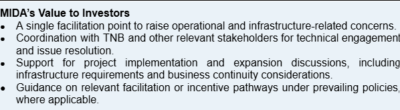
Recognising the importance of reliable infrastructure to investors, MIDA works closely with key infrastructure partners such as Tenaga Nasional Berhad (TNB) to support businesses beyond investment approval.
When electricity-related issues require specialist intervention, MIDA’s aftercare services connect investors with TNB so that concerns can be assessed by the appropriate technical teams and practical next steps identified.
This collaboration provides investors with a clear pathway – from identifying the issue and engaging with the relevant stakeholders to conducting a technical assessment and, where appropriate, developing mitigation measures. It allows companies to remain focused on their core operations while ensuring that infrastructure-related concerns are assessed by the appropriate technical experts.
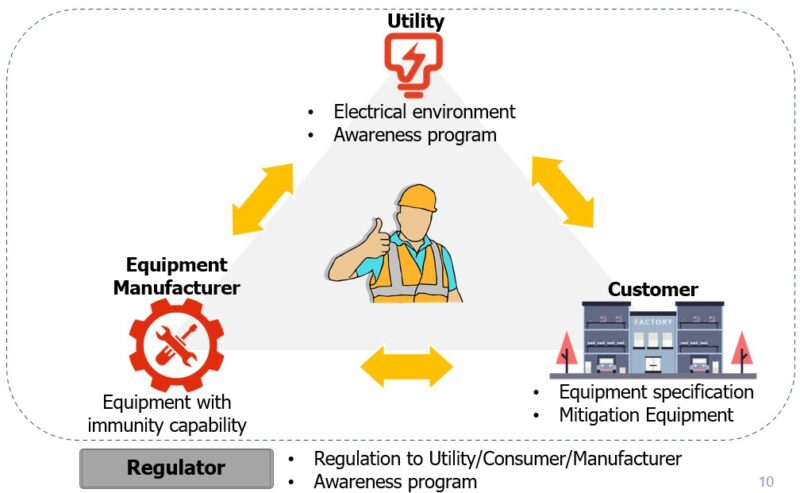
Power quality refers to the stability and consistency of electricity supplied to a facility. Poor power quality can lead to:
One common power quality disturbance is a voltage sag – a brief reduction in voltage that may last only a fraction of a second. Although electricity remains available, the disturbance may cause sensitive machinery, control systems, or electronic equipment to trip or shut down.
Voltage sags can arise from events such as lightning, vegetation interference, third-party activities, vandalism, or equipment failure. They may also originate within a facility, for example, when large motors or heavy machinery are started. While such disturbances cannot be completely eliminated, companies can strengthen the resilience of their facilities and reduce the operational impact.
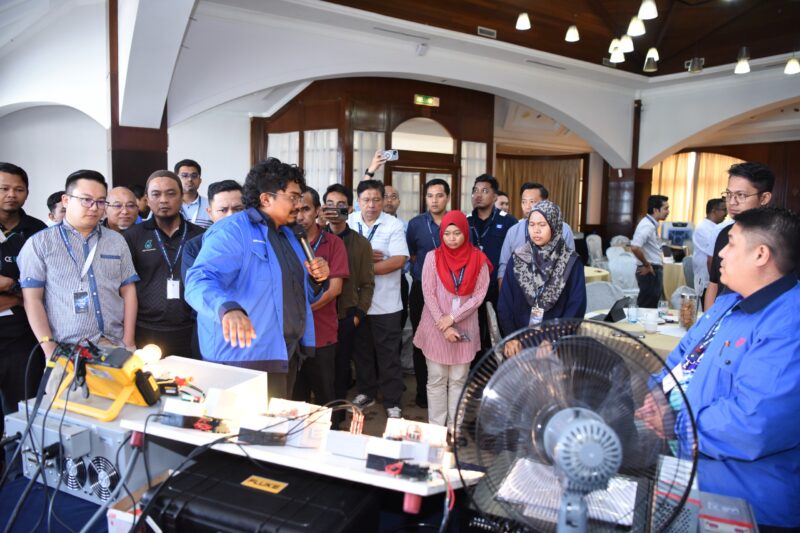
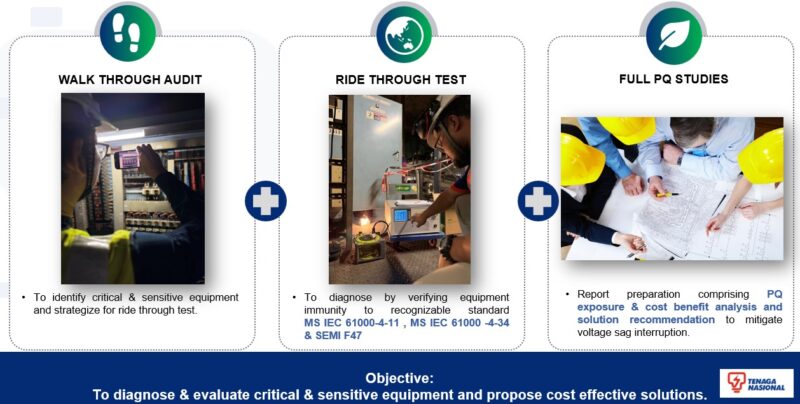
TNB supports customers through dedicated Power Quality (PQ) Services, covering three core areas: walk-through audits, ride-through tests and comprehensive PQ studies. These services help companies assess sensitive equipment, identify vulnerabilities, diagnose the source and impact of disturbances, and determine suitable mitigation measures.
TNB also operates an integrated Power Quality Monitoring System (PQMS) to monitor real-time PQ data, analyse trends and provide event alerts and reports to affected customers. This enables companies to understand their power quality performance, maintain operational records and take appropriate corrective action.
TNB’s Power Quality Assessment Service helps companies identify potential vulnerabilities before they disrupt operations. It examines how facilities and equipment respond to power disturbances and provide practical recommendations to improve reliability. By taking preventive action early, companies can avoid costly downtime and build more resilient operations.
Companies operating critical facilities may consider aligning their equipment with internationally recognised standards, including those of the International Electrotechnical Commission (IEC) and, where applicable, SEMI. These standards can help improve equipment immunity against voltage disturbances. Where appropriate, additional mitigation measures such as uninterruptible power supply (UPS) systems and other power quality solutions can further strengthen operational reliability.
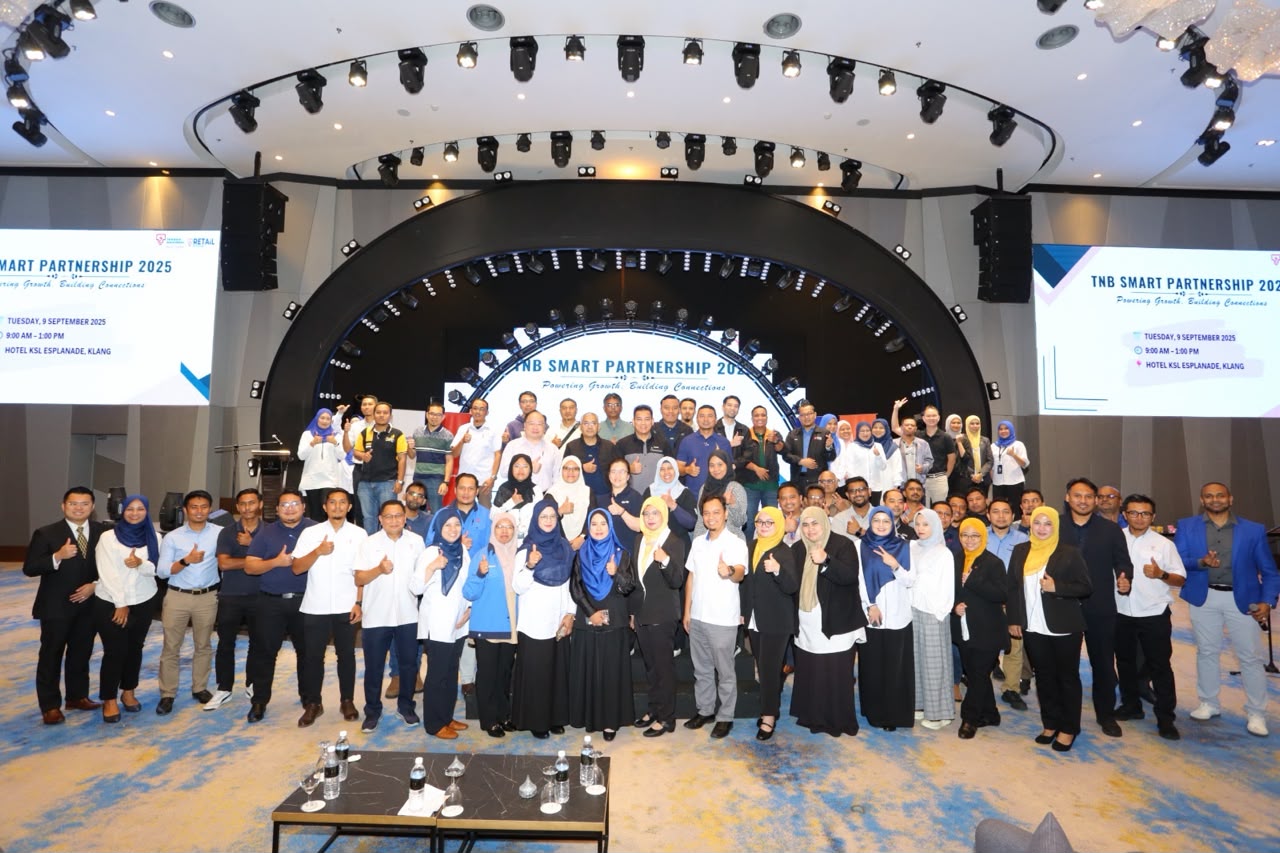
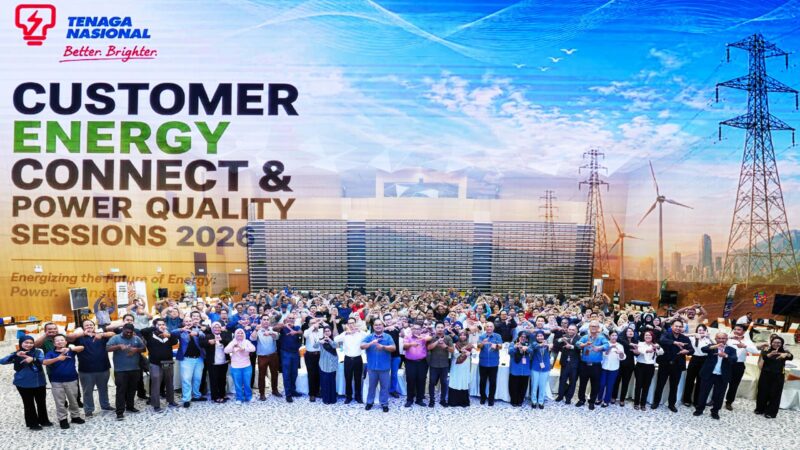
Beyond technical services, TNB also promotes knowledge sharing through annual Power Quality awareness seminars conducted with key stakeholders. In 2025, TNB organised 11 seminars involving 434 Large Power Consumers (LPCs) across the region, providing opportunities for companies to learn about industry best practices, exchange experiences and explore practical solutions to improve operational reliability.
The business value of proper diagnosis can be seen through the experience of Sensata Technologies (Malaysia) Sdn. Bhd., part of the global technology company specialising in sensing, electrical protection and control solutions.
The company experienced operational interruptions caused by voltage-sag-related disruptions, with estimated losses of approximately RM70,000 per incident. Following a power quality assessment and ride-through testing conducted by TNB, the secondary control equipment in the company’s chiller system was identified as particularly sensitive to voltage disturbances.
Instead of pursuing a costly plant-wide protection solution, the company implemented two targeted Power Quality Mitigation Equipment (PQME) units at a total cost of approximately RM25,000. Following the installation, disruptions declined from about 14 events annually to almost zero, with a reported return on investment in less than two months.
The case demonstrates an important principle for all power-sensitive operations; an effective response begins with an accurate diagnosis and applies the right intervention at the appropriate point.

Reliable power infrastructure is an important part of Malaysia’s broader energy transition, industrial development and growing digital economy. As Malaysia advances its energy transition agenda under the National Energy Transition Roadmap (NETR), companies are increasingly adopting energy-efficient technologies, smart energy management systems and solutions that optimise electricity consumption.
TNB is investing approximately RM43 billion to modernise and strengthen the national electricity grid. Its significant capital expenditure (CapEx) under Regulatory Period 4 (RP4), spanning 2025 to 2027, supports Malaysia’s energy transition through system upgrades, effective maintenance programmes and grid modernisation aimed at improving system security and reliability, while meeting rising electricity demand.
These investments will also support renewable energy integration and help Malaysia meet the increasingly complex requirements of advanced manufacturing, data centres and other high-value, technology-intensives activities.
For companies planning new facilities, expanding existing operations or facing recurring power quality concerns, early engagement can help reduce uncertainty and identify practical solutions before disruptions become costly.
Malaysia’s strength lies not in its infrastructure, but also in the coordinated ecosystem supporting investors throughout their investment journey. MIDA provides the investor-facing facilitation and coordination, while TNB contributes the technical expertise, monitoring capabilities and power quality services needed to address electricity-related operational risks.
For companies seeking to enhance operational reliability and safeguard business continuity, TNB’s free Power Quality Assessment Service offers a practical starting point for developing a more resilient and future-ready facility. Investors are encouraged to engage MIDA on project implementation and operational facilitation matters, and MIDA can coordinate with TNB when power quality expertise is required.
For technical enquiries or a free consultation on TNB PQ Services: [email protected]
Explore other related content to further
explore MIDA’s insights.