
2024 Archives - Page 64 of 77 - MIDA | Malaysian Investment Development Authority
English
contrastBtngrayscaleBtn oku-icon

|

plusBtn crossBtn minusBtn

|

This site
is mobile
responsive

sticky-logo

PM: Germany visit achieved both bilateral and investment objectives

Prime Minister Datuk Seri Anwar Ibrahim said his six-day visit to Germany has achieved its objective of not only strengthening the solid ties between the two countries, but also boosted trade and investment opportunities for Malaysia.

He said what was key were his lengthy discussions with German Chancellor Olaf Scholz, Vice Chancellor Robert Habeck and President Frank-Walter Steinmeier, which had touched on cooperation in investment, tourism, education as well as diplomatic issues including Gaza and Ukraine.

On investments, Anwar said Malaysia has secured new potential investment commitments totaling RM45.4 billion following meetings with 38 major companies.

The main investments, he said, would come from seven European companies which are based in Germany.

“Projects under X-Fab, Melexis and Schott Glass, which were approved in 2023 with a total investment value of RM4.45 billion, are expected to generate some 1,000 job opportunities,” he told the Malaysian media at the end of his six-day official visit to Germany today.

He said Infineon Technologies AG, Germany’s largest semiconductor manufacturer, has agreed to invest 5 billion euros in Malaysia while X-Fab will begin investing significantly in Sarawak.

He also noted that over the past week, reports from the Financial Times and New York Times has placed Malaysia as a major regional hub for the development of the semiconductor industry.

He said the visit to Germany also successfully secured an additional RM1.4 billion in potential sales of Malaysia’s export of products and services to Germany in the aerospace sector over the next 5 years to Airbus.

“Airbus, which already has a presence in Malaysia, has agreed to increase their investment in the country, with a focus on Negri Sembilan and Subang, Selangor,” he said.

The prime minister said he also met with top executives of Dutch semiconductor company Nexperia BV, including its chief executive officer Xuezheng Zhang.

Nexperia, he said, has expressed an readiness to make Malaysia their main investment destination.

Anwar said what made Malaysia an enticing investment destination for these companies were political stability and clear policies.

“Our green policies, including energy transition and renewable energy, our research in hydrogen and solar, these are among the factors which drew their attention to come and invest in Malaysia,” he said.

The prime minister said Malaysia’s participation in the SME Future Day in Berlin was also an eye-opener for German SMEs as the level of coverage accorded to the event in Malaysia was significant.

Anwar had delivered a keynote address at the event.

During his visit, the prime minister held a roundtable meeting with German captains of industry as well as private meetings with senior management of selected companies.

They included representatives from Schott AG; Siemens AG; B. Braun; X-Fab Silicon Foundries, Melexis, Volkswagen; Oldenburger Interior; PCC SE; Oryx Stainless; Fresenius; DELO Industries Klebstoffe; Airbus Asia Pacific as well as Airbus Malaysia; Infineon Technology, DHL; Bayer AG and others.

Germany has been Malaysia’s largest trading partner among European Union members since 2000, while Malaysia is Germany’s biggest trading partner in Asean.

In 2023, Malaysia’s total trade with Germany rose by 5.9 per cent to RM63.45 billion (US$13.90 billion) compared to RM59.87 billion (US$13.62 billion) in 2022.

Meanwhile, on world issues, Anwar said while Malaysia and Germany may share different viewpoints on the situation in Gaza, both nevertheless agree that a peaceful and humanitarian solution are imperative.

Anwar said he has extended invitations to Schulz and Habeck to visit Malaysia this year.

Source: NST

PM: Germany visit achieved both bilateral and investment objectives


Content Type:

Duration:
Real estate outfit IQI Group is establishing a high-tech manufacturing park in Cambodia’s Kandal province, where the initial phase will have a gross development value of US$300 million that could potentially attract investors from Malaysia.

Daniel Ho, co-founder and group managing director of IQI, revealed that the first phase of the development will cover up to 100 hectares. 

Subsequent phases aim to expand the park to as much as 2,000 hectares, equivalent to 20 square kilometres, he said.

“We have ambitious goals for this high-tech park. Our objective is to create a sustainable high-tech ecosystem for multi-national companies to thrive and to be able to tap into the rewarding ASEAN market,” Ho said.

He emphasised IQI’s vision to transform the area into a thriving industrial hub within five years, attracting both local and international high-value industry players.

In addition to leveraging their platforms to attract manufacturing tenants, IQI and its parent company, Juwai IQI, intend to facilitate cross-border investment and development for corporate clients, particularly from Malaysia, China, and global markets.

IQI has solidified its commitment to the high-tech park through a memorandum of understanding (MoU) with Premium Housing Group, witnessed by Minister of Digital Gobind Singh Deo and Ambassador of Malaysia to Cambodia, Datuk Eldeen Husaini Mohd Hashim.

Chandy Mann, founder of Premium Housing Group, highlighted their extensive landbank and commitment to timely and budget-conscious project delivery. 

“As we plan the first stage of the park, we are working with renowned engineers and top-tier architects to conceptualise the project, so we can offer outstanding facilities to our tenants. We will ensure all designs and engineering comply with ESG standards,” he said.

Mann extended an invitation to like-minded manufacturers, emphasizing the park’s advanced amenities, strategic location, robust infrastructure, and skilled workforce as key benefits for prospective tenants.

 Meanwhile, a seasoned real estate consultant has identified 2024 as an opportune time for real estate investments in Cambodia, noting an anticipated surge in interest from Malaysian companies.

“The market is experiencing a revival as it aligns with the country’s economic growth trajectory.

“Emerging from a prolonged period of stagnation, factors such as increased tourism, rapid urbanisation, and the expansion of the middle class are fueling the growing appeal of the region,” he told NST Property.

Source: NST

IQI to set up manufacturing hub in Cambodia, potentially drawing investors from Malaysia


Content Type:

Duration:

Malaysian Investment Development Authority (Mida) said Malaysia has been ranked 27th place in the recent Global Opportunity Index (GOI) 2024 report by the Milken Institute.

The institute distinguished Malaysia as the leading nation among Asia’s emerging and developing countries in terms of overall investment conditions.

“Malaysia’s commendable global rank of 27, surpassing regional competitors like Thailand and China, marks a significant milestone in the nation’s economic development journey,” said Mida in a statement.

Surpassing its counterparts in all five five categories of the Global Opportunity Index, Malaysia offers a comparatively lower-risk investment landscape, setting it apart from other developing Asian markets, read the statement.

“Notably, the recent strategic working visit to Germany, led by the Prime Minister Datuk Seri Anwar Ibrahim, together with the Minister of Investment, Trade, and Industry Tengku Datuk Seri Zafrul Abdul Aziz, marked a significant milestone with prospective investments amounting to RM45.4 billion,” added Mida.

This venture, it said, coupled with a separate mission to Australia, resulted in commitments from Australian companies to invest RM24.5 billion.

Source: The Edge Malaysia

MIDA: Malaysia ranks 27th in Milken Institute’s Global Opportunity Index


Content Type:

Duration:

The Northern Corridor Implementation Authority (NCIA), in collaboration with the Penang government, has facilitated a significant investment of RM13.67 billion in Penang last year, resulting in the creation of over 14,000 job opportunities.555500:10/01:59

Chief Minister Chow Kon Yeow commended NCIA for its role in attracting such substantial investments, which he attributed to investors’ confidence in Penang’s long-term prospects and the Northern Corridor Economic Region (NCER) as a whole.

Chow expressed appreciation for NCIA’s efforts to enhance Penang’s appeal to investors, particularly in areas such as technology development and skilled talent, beyond the traditional sectors of Electrical and Electronics (E&E) and Machinery and Equipment (M&E).

He highlighted the NCER Technology Innovation Center (NTIC) as an example of a program aimed at bolstering the industrial ecosystem, fostering innovative activities, research and development (R&D), and enhancing the value chain for small and medium enterprises (SMEs).

“(These initiatives) will further establish Penang as a hub for technology and innovation in the region.”

Chow made these remarks at an appreciation ceremony for companies involved in the Center of Excellence (CoE) Programme under NTIC, following a meeting of the Penang state steering committee.

He attributed Penang’s remarkable investment inflow of RM71.9 billion in 2023, the highest in Malaysia, to the state’s clear, investor-friendly, and competitive economic policies at the regional level.

“Undoubtedly, this extraordinary growth was driven by foreign direct investment (FDI) which accounted for RM61.7 billion or 85.81 per cent of Penang’s manufacturing investment inflow in the period in question.”

NCIA chief executive Mohamad Haris Kader Sultan credited the RM13.67 billion investment success to close cooperation with stakeholders, including the federal and state governments, as well as state government agencies.

He noted that investments covered focus sectors outlined in the NCER Strategic Development Plan, such as manufacturing, agribusiness, logistics, digital economy, and tourism.

Haris also highlighted the positive impact of the NCER’s talent development program, which has benefited over 4,955 micro, small, and medium enterprises (MSMEs) and created more than 16,100 job opportunities in Penang.

During the NTIC program’s certificate presentation ceremony, five companies were appointed as CoE providers for NTIC, focusing on supporting local SMEs under the NTIC CoE User programme.

“So far, there are eight SME companies in Penang that have registered for the NTIC CoE User programme.

“Twelve NTIC CoE providers from Penang have been appointed since the launch in May 2023 with a total of RM73.67 million investment recorded,” he added.

NTIC, an initiative focusing on research, design, technology, innovation, and commercialization, serves as a primary platform to attract technology-related businesses to NCER, particularly in Penang, through collaboration between local SMEs, multinational companies, and academia.

Source: NST

Penang’s economic triumph: RM13.67 billion investment, 14,000 jobs created in 2023


Content Type:

Duration:

The Milken Institute’s recognition underscores the effectiveness of Malaysia’s economic policies and the concerted efforts of all stakeholders, including government agencies, industry players, and the investment community, said the Malaysian Investment Development Authority (Mida).

According to its Global Opportunity Index (GOI) 2024 report, Malaysia was recognised as the leading nation among Asia’s emerging and developing nations in terms of overall investment conditions.

Mida said Malaysia’s commendable global rank of 27, surpassing regional competitors like Thailand and China, marks a significant milestone in the nation’s economic development journey.

“The prestigious ranking was a direct reflection of the relentless efforts by the government, spearheaded by the Investment, Trade, and Industry Ministry (Miti), with Mida playing a crucial role in enhancing the ease of doing business and smoothing out the investment process across the nation,” it said in a statement today.

Notably, the recent strategic working visit to Germany marked a significant milestone with prospective investments amounting to RM45.4 billion, coupled with a similar mission to Australia, which resulted in commitments from Australian companies to invest RM24.5 billion.

Mida chief executive officer Datuk Arham Abdul Rahman said the investment promotion agency is dedicated to building upon this success by continually enhancing its services and support systems for investors.

“Our goal is to not only maintain Malaysia’s position as a prime investment destination in Asia but also to elevate our standing on the global stage.

“We are devoted to making Malaysia the ultimate investment sweet spot by ensuring a more seamless and efficient investment process across the nation,” he said.

In line with the sentiments expressed by Investment, Trade, and Industry Minister Tengku Datuk Seri Zafrul Abdul Aziz, Mida reiterated its commitment to addressing the key pain points along the investor’s journey and optimising the investment climate in Malaysia.

It said future initiatives will focus on digitalisation, sustainability, and innovation, ensuring Malaysia remains attractive to sectors pivotal for future economic growth and in sync with current policies, namely the New Industrial Master Plan 2030, the National Energy Transition Roadmap, and the 12th Malaysia Plan.

“Mida’s strategic approach includes enhancing partnerships, both locally and internationally, to foster a collaborative investment environment.

“These efforts are part of a broader national strategy to secure Malaysia’s position as the gateway to Asia for investors seeking growth, innovation, and sustainability,” it said.

Mida, in collaboration with Miti and other ministries and agencies at both the Federal and state levels, will continue to drive forward Malaysia’s investment agenda and ease of doing business, leveraging the country’s strategic location, political stability, robust infrastructure, and dynamic workforce.

Source: Bernama

Milken Institute’s recognition highlights Malaysia’s economic policies’ effectiveness – MIDA


Content Type:

Duration:

Deputy Premier Datuk Amar Awang Tengah Ali Hasan yesterday met several potential investors in Singapore to explore investment opportunities in Sarawak.

Among them was Kuok Group, represented by Kuok Meng Wei, to discuss the potential of the company investing in green and renewable energy projects in the state.

Kuok is also the chief executive officer and managing director of K2 Strategies.

“The Deputy Premier welcomes the interest (of investment) from the company as it is in line with the Post Covid-19 Development Strategy 2030,” said a press release issued following the visit in Singapore yesterday.

Another press release said Awang Tengah, who is Minister for International Trade, Industry and Investment, also took time to discuss with investors from UOB Group, Eastspring Investments, Two Family Office and Chemsain to explore investment opportunities in Sarawak, especially in the renewable energy as well as green and digital economy projects.

Among those present were Sarawak Timber Industry Development Corporation general manager Zainal Abidin Abdullah and advisor Datu Hashim Bojet, InvestSarawak chief executive officer Timothy Ong and Pusaka Capital Sdn Bhd chief executive officer Mohamad Nor Topek Julaihi. 

Source; Borneo Post

Sarawak deputy premier meets several potential investors in Singapore


Content Type:

Duration:

Malaysia’s upstream oil and gas (O&G) industry remains vibrant and continues to attract investors or petroleum arrangement contractors (PACs), as evidenced by participation in previous petroleum bidding rounds, said BMI.

The Fitch solutions company reckoned that the nation’s upstream sector is poised for further growth in 2024 as the government continues to promote offshore blocks for exploration.

In 2023, Malaysia made significant progress in the upstream oil and gas segment as Petroliam Nasional Bhd (Petronas) and PACs recorded 21 exploration discoveries and two exploration-appraisal successes.

According to Petronas, all discoveries could contribute to over 1 billion barrels of oil equivalent of new resources for Malaysia in 2023, with 16 discoveries located in the Balingian, West, and Central Luconia basins of Sarawak, while three others are located in Sabah, BMI said.

“New discoveries certainly boosted Malaysia’s efforts to reverse declining O&G production and could support its liquified natural gas (LNG) production and exports,” it said in its industry trend analysis today.

It also highlighted that Petronas has made a good start to 2024, securing seven production sharing contracts (PSCs).

The Malaysia Petroleum Management (MPM), which manages Malaysia’s oil and gas reserves, awarded seven PSCs for six exploration blocks and one discovered resource opportunities (DRO) cluster offered under the Malaysia Bid Round 2023 (MBR 2023).

The new PSCs were awarded to Petronas, E&P Malaysia Venture Sdn Bhd (EPMV), Petroleum Sarawak Exploration & Production Sdn Bhd (PSEP), SMJ Energy Sdn Bhd, INPEX Malaysia E&P, PT Pertamina Malaysia Eksplorasi Produksi, Jadestone Energy Inc, Sarawak Shell Bhd and E&P O&M Services Sdn Bhd.

Petronas estimated that the contracts are expected to generate more than RM1.3 billion (US$277 million) worth of capital investment in the exploration activities.

In total, BMI said Malaysia has signed nine PSCs in the first quarter of 2024.

It said Petronas has also launched the Malaysia Bid Round 2024 (MBR 2024), offering five exploration blocks and five DRO clusters to potential investors.

“The winners of the bid round are expected to be announced in the third quarter of 2024.

“The successive launches of petroleum bidding rounds, with a focus on natural gas exploration and production, suggest that natural gas would remain a vital component of Malaysia’s energy supply mix,” it noted.

BMI added that new oil and gas discoveries are essential to support Malaysia’s long-term energy security, but it remains uncertain whether all new discoveries will be developed.

“However, incentives to develop stranded oil and gas resources remain high, given the sustained strength in global oil and gas prices and upward projections for domestic natural gas demand growth as well as to support Malaysia’s oil and gas production targets of two million barrels of oil equivalent per day by 2025 and beyond.

Source: Industry

Malaysia’s upstream O&G industry remains attractive to investors — BMI


Content Type:

Duration:

Bridge Data Centres International Pte Ltd (BDC) has reinforced its collaboration with Tenaga Nasional Bhd (TNB) through the signing of the Electricity Supply Agreement (ESA) for its forthcoming data centre venture in Malaysia.

The ESA, which was executed on March 7, 2024, signifies TNB’s commitment to furnish additional power resources to facilitate BDC’s expansion plans for its data centre presence in Johor.

BDC’s alliance with TNB commenced in 2022, when it initially received 275 kV of utility power from TNB to support its inaugural hyperscale data centre endeavor.

Two years later BDC is in the process of developing another data centre campus, emphasising lower Power Usage Effectiveness (PUE) standards within the region.

Construction of the facility is progressing according to schedule, with the first phase of the core and shell building nearing completion, it said in a statement.

BDC, a key player in the Asia Pacific data centre market, said it anticipates achieving the Certificate of Completion and Compliance (CCC), a mandatory statutory requirement, in the earliest phases soon.

The company’s president Eric Fan said throughout its journey to advance digital connectivity and the digital economy of the country, TNB and various Malaysian government agencies at both the state and federal levels have provided unwavering support to BDC. 

“We are grateful for this support and confident that our partnership will continue to grow stronger in the years ahead,” he said.

BDC is a subsidiary of Chindata Group, which in turn is a carrier-neutral hyperscale data centre solution provider in global emerging markets.

Source: NST

Bridge Data Centers signs electricity supply agreement with TNB For its data center in Johor


Content Type:

Duration:

Malaysia has been ranked as the country with the best overall investment condition among Asia’s emerging and developing (E&D) nations in US economic think tank Milken Institute’s Global Opportunity Index (GOI) 2024.

Globally, Malaysia has an overall ranking of 27, ahead of Thailand (37) and China (39).

Commenting on the achievement, Investment, Trade and Industry Minister Tengku Datuk Seri Zafrul Abdul Aziz said it is a testament to Malaysia’s efforts in enhancing the ease of doing business and addressing key pain points along the investor’s journey.

“We are deeply encouraged by this recognition, which speaks volumes of our focus on efficient implementation of approved investments. This recognition will spur us towards delivering even better service to help investors make Malaysia their gateway to Asia,” he told Bernama when asked to comment on the report.

The report said that E&D Asia has the third-largest GOI range between the top- and bottom-ranked countries among E&D regions.

It said four of the top 10 countries in E&D Asia rank above the E&D overall average in five categories of the GOI.

“The categories are business perception, economic fundamentals, financial services, institutional framework and international standards and policy,” it said.

Milken Institute said Malaysia, the country with the best investment conditions in the region, performed significantly above the E&D average in financial services and institutional frameworks.

“This country’s exceptional performance in institutional frameworks is partly due to its strong investors’ rights, ranking fifth overall in this subcategory of the GOI.

“In addition to Malaysia, China, the region’s largest economy, scores significantly above the E&D average on financial access and financial size and conditions, the two subcategories included in financial services,” it said.

Milken also found that E&D Asia performed relatively well in financial services, with its average score in this category closely trailing that of E&D Europe and ahead of other E&D regions.

“This region includes Malaysia, which has the best investment conditions (captured by the highest GOI score) among all E&D economies.

“In addition to its robust business perception and financial services, Malaysia ranks relatively high in the institutional framework category, partly due to the strength of investors’ rights in this country,” it added. 

Source: Bernama

Malaysia best in overall investment conditions among Asia’s emerging nations — Milken Institute


Content Type:

Duration:

Construction cranes still surround the brand-spanking-new plant in Kulim’s industrial park in Malaysia. But inside, legions of workers hired by Austrian tech giant AT&S are already gearing up to produce at full capacity by year’s end.

Outfitted in head-to-toe coveralls, with oversized safety glasses and hard hats, they’re reminiscent of the worker bees in the movie Minions, but colour coded by function: Blue for maintenance. Green for vendors. Pink for janitors. White for operators.

AT&S is just one of a flood of European and American companies that have recently decided to move to or expand operations in Malaysia’s electrical and electronics manufacturing mecca.

US chip giant Intel and German corporation Infineon are each investing US$7bil (RM32.81bil). Nvidia, the world’s leading maker of chips powering artificial intelligence, is teaming up with the country’s utilities conglomerate to develop a US$4.3bil (RM20.15bil) artificial intelligence cloud and supercomputer center. Texas Instruments, Ericsson, Bosch and Lam Research are all expanding in Malaysia.

The boom is evidence of how much geopolitical friction and competition are reshaping the globe’s economic landscape and driving multibillion-dollar investment decisions. As rivalries between the United States and China over cutting-edge technology simmer and trade restrictions pile up, companies – particularly those in crucial sectors like semiconductors and electric vehicles – are looking to strengthen their supply chains and production capabilities.

AT&S had production sites in Austria, India, South Korea and China – its largest plant – when it started hunting for a new location.

“It was clear after 20 years of investment in China, we needed to diversify our footprint,” AT&S CEO Andreas Gerstenmayer said. The company manufactures high-end printed circuit boards and substrates, which serve as the foundation for advanced electronic components that power artificial intelligence and supercomputers.

The company’s site search started in early 2020, just as warnings began to spread about a dangerous new coronavirus in China. AT&S scouted 30 countries on three continents before settling on Malaysia.

South-East Asia’s strategic position in the South China Sea and long-standing economic ties to China and the United States make the region an attractive place to set up shop. Nations like Thailand and Vietnam, AT&S’ second choice, are also aggressively courting semiconductor firms to expand, offering tax incentives and other lures.

But Malaysia has the advantage of a head start.

The country has been riding the tech wave since the 1970s when it energetically courted some of the world’s electrical and electronic superstars, like Intel and Litronix (now ams Osram, with headquarters in Austria and Germany). It created a free-trade zone on the island of Penang, offered tax holidays, and built industrial parks, warehouses and roads. Cheap labour was an additional draw, as was its large English-speaking population and stable government.

Malaysia’s history in the back end of making semiconductors was one of the primary draws, Gerstenmayer said.

“They are quite aware of what the needs of the semiconductor industry are,” he said. “And they have a well-developed ecosystem in the universities, in education, labour force, supply chain” and more. Support from the government was another attraction, he said.

Tengku Zafrul Aziz, Malaysia’s minister of investment, trade and industry, said foreign investment began to pick up in 2019, driven by the widening use of semiconductors in everything from automobiles to medical devices. “There’s 5,000 chips in one car,” he said.

After the Covid-19 pandemic revealed devastating weaknesses in global supply chains, interest in Malaysia as an additional source soared.

That trend accelerated as great power conflicts bubbled over.

Both China and the United States moved to forge their own reliable semiconductor supply chains, in addition to supporting other critical sectors like renewable energy and electric vehicles.

“US and European companies and even Chinese companies wanted to diversify out of China,” Zafrul Aziz said. China, too, is locating production facilities outside the mainland, in part, some say, to sidestep US sanctions. It’s a “China plus one” strategy.

Worries about Taiwan, the world’s largest producer of semiconductors, has further fueled investment in Malaysia, he said. The island is a source of growing friction between China, which maintains Taiwan is part of its territory, and the United States, which supports it politically.

Malaysia is already the world’s sixth largest exporter of semiconductors, and packages 23% of all American chips.

“For a country of this size to be having that big an impact on the global semiconductor market is quite fantastic,” said David Lacey, director of advanced development and services at Osram, one of the world’s largest lighting companies.

Seated at a large conference table at the Sciences University of Malaysia on Penang, he rapidly pointed to the technology around the room. “There’s a TV, there are lights, there’s a projector, there are phones,” he said. “You can pretty much guarantee there is a Malaysia component somewhere.”

The proximity of so many tech companies also exerts a gravitational pull. In Penang and Kulim, which are connected by two long, snaking bridges, there are more than 300 companies.

“Everything is here,” said Eric Chan, a vice-president and general manager at Intel in Malaysia. After a half century, that network and infrastructure are not easily duplicated.

Chan also mentioned the government’s crucial cooperation during the pandemic in keeping factories open.

Foreign direct investment was nearly US$40bil (RM187.50bil) last year, more than twice the total generated in 2019.

Mario Lorenz, managing director in Malaysia for the German logistics company DHL Supply Chain, said “most of our big investments have happened in the last two years”.

During that time, the semiconductor sector has grown to dominate the company’s business in Malaysia. “We followed the trend,” he said.

Inside DHL Supply Chain’s newest global distribution center, Penang Logistics Hub No. 4, are bespoke orange and blue shelves specifically designed to handle the heavy, oversized crates used by a semiconductor company.

Four new supply chain facilities are in the works in Malaysia.

Malaysia’s track record has been mostly in the back end of the semiconductor supply chain – which includes packing, assembling and testing components – activities that traditionally have been considered less complex and of lower value.

But now the industry’s focus on packaging smaller chips – chiplets – more tightly together to increase computing power is increasing the value and technical complexity of those activities.

Intel is building its first overseas facility for advanced 3D chip packaging in Malaysia. When you bring in cutting-edge technology there is a “ripple effect”, said AK Chong, a vice president and managing director of Intel in Malaysia. That development will attract dozens of new businesses and help advance the labour force’s entire skill set.

Although such advancements will require a huge expansion of utilities like green energy, sanitation, water and a 5G digital infrastructure, several company executives said they were confident of the Malaysian government’s commitment.

“They have projects to provide green energy by building up big solar farms,” Gerstenmayer said. “Malaysia is on good path to becoming a hot spot in the electronics industry globally.”

Source: The Star / The New York Times

Malaysia rises as crucial link in chip supply chain


Content Type:

Duration:

Proton Holdings Bhd’s collaboration with Chinese carmaker Geely has not marginalised local vendors and suppliers, said industry specialist Hezeri Samsuri.

He emphasised that the usage of locally sourced parts in car manufacturing has actually increased.

He said the use local components is scrutinised by the Investment, Trade and Industry Ministry.

In light of the concerns raised by suppliers and vendors affiliated with Proton on escalating operational expenses, Hezeri said there will always be vendors who are dissatisfied.

“According to my sources, there are many other vendors who are willing to take their slots.

The ministry should conduct surprise inspections of not only car companies but also vendors.  

“We do not want vendors assembling imported parts and then claiming them to be local.

Some sort of local raw material should be in play.” The Proton Vendors Association (PVA) comprising 77 companies claimed that they are facing severe financial strains due to escalating operational expenses and lower volume of sales.

PVA is recognised as a representative of the automotive components sector in Malaysia.

Members include units of large outfits like UMW Holdings Bhd, Sime Darby Bhd, Sapura Group Bhd, Pecca Group Bhd, APM Automotive Holdings Bhd (part of the Tan Chong group of companies) and EP Manufacturing Bhd.

According to Datuk Low Kok Chuan, president of the Malaysia Fujian Chamber of Commerce and Industry (MFCCI), despite PVA reaching out to Proton to address the challenges, their appeals have been disregarded.

Low claimed that many vendors are grappling with financial issues attributed to dwindling orders, especially since early last year, leading to an unsustainable business environment.

He cautioned that if this situation persists, it could lead to many vendors going bust.

He attributed the root cause to Proton’s failure to fulfil the promised quantity of parts orders for its X50, X70, and X90 models, which has resulted in a significant reduction in output by almost 50 per cent.

Consequently, many vendors are experiencing financial losses, forcing some to cease operations altogether, he claimed.

Ricky Tan, the treasurer-general of MFCCI and the auditor for PVA, claimed that even though Proton had originally contracted vendors to supply parts for 1,500 cars each month, that number has now dropped to 200 to 300 cars per month.

“Some members have suffered financial losses as a result of this significant decline in orders.” In response to the concerns raised by vendors, Proton affirmed its readiness to engage in fair discussions with all PVA members, except those who are unable to provide clear evidence regarding the issues raised.

“At Proton, we create an equitable and respectful business environment with our partners built on our unwavering commitment to fair and firm business dealings.  

“To achieve this, we collaborate closely with PVA, the official representative for all 116 Proton vendors, having frequent discussions and joint initiatives that are mutually beneficial,” it said in a statement.

Acknowledging the difficulties faced by certain vendors, Proton reiterated its commitment to open dialogue.  

The national car company also expressed empathy for the challenges they are encountering.

Proton underscored its history of transparent and constructive dialogue and affirmed its dedication to maintaining this approach in the long term.

“We recognise the importance of resolving matters quickly by working closely with all parties involved and inviting engagement via official channels.”

Meanwhile, Hezeri said vendors who are significantly impacted may have to close down, but he noted that many automotive vendors do not depend on one manufacturer alone.  

Although there are many reasons why a company has to wind down, he said this matter still requires investigation.  

“The closure of the Goodyear factory in Shah Alam is a good example of how its cost-cutting effort. Hoping for cheap labour is a short-term solution as workers demand a higher salary.  

“I would say the future for Malaysia is in the manufacturing and production of high tech components due to increasing labour costs.  

“It is high time Malaysia became a producer and not just an assembler,” he said.  

Universiti Kuala Lumpur Business School economic analyst Associate Prof Aimi Zulhazmi Abdul Rashid said one of the conditions given by the government when Geely offered to partially acquire Proton was to develop and enlarge the local vendor network and increase the local parts percentage.

“A study should be conducted to determine whether the target has been achieved on the back of globalisation of the first national car icon.

“A good comparison would be the second car project in Perodua, the supply chain of parts.

Good points from both projects must be shared in order to boost the automotive industry,” he added.

Source: NST

Industry specialist says Proton-Geely collaboration has not marginalised local vendors, suppliers


Content Type:

Duration:

Malaysia has begun exploring the possibility of restarting discussions on the Malaysia-European Union Free Trade Agreement (MEUFTA), which has been stalled since 2012.

The MEUFTA was among the issues discussed between Prime Minister Datuk Seri Anwar Ibrahim and German vice-chancellor Robert Habeck, who is also Germany’s federal minister for economic affairs and climate action.

Their meeting was held on the sidelines of the annual SME Day, – also known as the Mittelstand – at STATION Berlin here today.

Anwar said they were hoping for a positive outcome of the scoping exercise between technical experts of both sides.

“We hope to move forward on MEUFTA soon and for both sides to start discussions,” he said.

Negotiations on the MEUFTA were formally launched on Oct 5, 2010, with eight rounds of negotiations between Dec 2010 and Sept 2012.

However, the negotiations reached an impasse in 2012 as both sides had had exhausted their negotiating options at that time.

It was subsequently agreed that negotiations will resume when a fresh mandate and/or flexibilities become available to both sides.

Germany is Malaysia’s largest trading partner within the European Union, with a trade value of almost US$14 billion.

Total investments in manufacturing projects meanwhile totalled US$14 billion, involving companies such as Infineon, B. Braun, Osram and Bosch, creating over 70,000 jobs.

Anwar is on a six-day visit to Germany, his first since becoming prime minister. He had engagements with various companies and captains of industry from all over Germany, which have already resulted in new investments pledges amounting to 868 million Euros (RM4.45 billion).

Meanwhile, Anwar, in his talk with Habeck, also expressed concern that EU policies on climate change including its Deforestation Regulation may serve as a form of non-tariff trade measure.

The prime minister urged Germany to adopt a more inclusive and fair approach.

On March 6, Plantation and Commodities Minister Datuk Seri Johari Abdul Ghani said the World Trade Organisation (WTO) panel had issued its final report and concluded that the European Delegated Act that restricted palm oil biofuels, was deemed discriminatory towards the country’s palm oil biofuel.

The dispute dates to 2018 when the EU issued regulations on the minimum amount of renewable fuels that member countries must use in their transport sectors.

The EU stipulated that the use of biofuels for which forests had been cleared for planting could not be used to achieve this target. This primarily concerned oil palm crops.

Malaysia, which has a major palm oil production industry, had defended that the measures violated fair trade practices and launched a lawsuit against the WTO in 2021.

Anwar said he also expressed to Habeck Malaysia’s interest in joining the Climate Club, a 38-member intergovernmental forum for exchange on industry decarbonisation.

Malaysia, he said, also welcomed Germany’s support in capacity-building, technology transfer and financial assistance.

On capacity building and skills enhancement, Anwar proposed a collaboration to boost skills of Micro, Small and Medium Enterprises (MSME) via joint trainings, workshops, mentorship programmes.

Source: NST

Malaysia exploring possibility of restarting discussions on Malaysia-EU FTA


Content Type:

Duration:

Malaysia today made an open invitation to German firms, as well as businesses across Europe, to engage, invest, and partner with a dynamic, strategic and growing Malaysia.

In making the call, Prime Minister Datuk Seri Anwar Ibrahim said Malaysia has a skilled labour force, modern infrastructure, a clear regulatory environment, and huge growth potential.

“We are a dynamic economic fit for the 21st century and the perfect partner for German businesses,” he said in his keynote address at the SME Day here.

Held at the Berlin Station and organised by the German Association for Small and Medium-sized Businesses (BVMW), it brings together about 5,000 SMEs with prominent government and corporate figures.

Anwar, who is on a six-day official visit to the third largest economy in the world, said Malaysia also provides Germany with a strategic gateway into the wider Asean market. “Asean is set to emerge as the world’s fifth-largest economy by 2030. The region is primed for exponential growth,” he added.

Over the past decade, Germany has remained Malaysia’s top trading partner in the European Union, while Malaysia is now the country’s largest trading partner in Southeast Asia.

Bilateral trade has grown by leaps and bounds, at an annual average of 5.2 per cent. Malaysia continues to be an attractive destination for FDIs with German companies investing €8.5 billion (RM43.6 billion) as of 2023.

Anwar, who is also the finance minister, said foreign investors can benefit from various efforts taken by the government to ease the doing of business, build confidence in the Malaysian system, and ultimately, ensure long-term stability in the country.

SMEs and the digital economy During meetings with German businesses and investors, Anwar told them Malaysia is also a gateway to the Halal ecosystem and the digital economy. He told them as Germany aims to penetrate halal markets, Malaysia, a leader in the multibillion-dollar industry, stands as an ideal partner, offering expertise, infrastructure, and a robust halal regulatory framework.

In his speech today, the prime minister also said that both countries and their economies are built on a common foundation, which is small and medium enterprises (SMEs), although Germany’s SME sector is huge.

Anwar said Germany is a source of inspiration as it emerged strongly and confidently despite its cities being destroyed after World War Two.

He noted that more than 700 German companies are operating in Malaysia, including giants such as Siemens, Infineon, and Volkswagen. He added that German firms can work together with Malaysia to develop renewal energy.

The prime minister also took the opportunity to promote Malaysia as a tourism hub, saying that the country is rich with forests and beaches that can be visited throughout the year.

While encouraging SMEs to embrace green initiatives, including ESG practices, he said the Malaysian government is also doubling down on the digital economy, with a strong focus on promoting digital technologies to SMEs to drive export growth.

Six Malaysian companies are participating in the exhibition here through the Ministry of Entrepreneur and Cooperatives Development (MECD).

Source: Bernama

PM Anwar invites German, European firms to invest in Malaysia


Content Type:

Duration:

Launch of modern plant aims to minimise illegal dumping to achieve zero carbon emissions by 2050

J&T Berjaya Alam Murni Sdn Bhd launched its Scheduled Waste-to-Energy (SWTE) plant at the Bukit Tagar Enviro Park yesterday, marking a milestone in the strategic collaboration between Berjaya Enviro Group of Companies Malaysia, J&T Recycling Corporation Japan and JFE Engineering Corp Japan.

Environment Department deputy director-general (operations) Dr Norhazni Mat Sari officiated at the event, which was also attended by J&T Berjaya Alam Murni managing director Koh Chee Yong, JFE Engineering president Hajime Oshita, Malaysian Investment Development Authority deputy CEO Sivasuriyamoorthy Sundara Raja and Japanese ambassador to Malaysia Katsuhiko Takahashi.

Koh said the project would enhance the circular economy and the cradle-to-cradle concept emphasised by the department, in which modern facilities convert waste into resources and renewable energy.

Such facilities include the 12MW Landfill Gas to Renewable Energy plant and the 100% Scheduled Waste to Alternative Raw Material Recycling plant.

“We got involved in the scheduled waste business by recycling 100% of it in 2017. In 2019, we started this project, which treats scheduled waste with a heat energy recovery system to increase its recycling rate.

“At present, we can handle 76 out of 77 varieties of scheduled waste in Malaysia and serve over 300 clients, primarily from the industrial sector involved in scheduled waste management.”

Koh said the bulk of the solid and scheduled waste J&T Berjaya Alam Murni receives comes from Kuala Lumpur, Hulu Selangor and Selayang.

“Our facility is equipped to handle scheduled waste for up to 400 years, providing clients with the assurance that they can send it to us without worrying about the disposal process.

“It can accept various types of waste for treatment, and then recycle or convert it into resources, and ultimately dispose it.”

Koh said the facility is situated within the Bukit Tagar Enviro Park and occupies about 263ha, with a buffer zone that has been gazetted for waste disposal by the Selangor government and the Hulu Selangor Municipal Council.

He said the facility aims to support efforts to minimise illegal waste dumping to achieve zero carbon emissions by 2050, with a 500m buffer zone maintained from any residential area as stipulated by the state government.

“The SWTE plant is a significant step that effectively sets the benchmark for sustainable waste management,” he said, adding that maintaining client loyalty to use the waste disposal services may pose challenges in the initial stages.

“However, one of our many plus points is that we can quantify carbon emissions when waste is sent to us, compared with sending it to unlicensed facilities or illegal dumping sites.

“This means companies can accurately quantify carbon emissions from their waste management activities for inclusion in their sustainability or annual reports and measure the actual reduction achieved.”

Koh said currently, the company stands as the only sustainable scheduled waste treatment centre in Peninsular Malaysia that offers a comprehensive solution for solid and scheduled waste management.

He said the recycling rate at the facility now stands at 30%.

But with the government’s initiative and market forces at play, this can be enhanced to achieve some 70% if it does not focus only on treatment and disposal.

Koh added that to bolster the management, operation and maintenance of the SWTE plant, some 250 job opportunities will be made available to residents.

Source: The Sun

Milestone in converting waste to renewable energy


Content Type:

Duration:

Expansion into Southeast Asia is a priority of Tesla, Rohan Patel, a senior executive of the United States (US) automotive company, said on March 12, highlighting the fast-growing market where the company faces competition from China’s BYD.

In his recent post on the X social media platform, formerly known as Twitter, the senior public policy and business development executive at Tesla said that Southeast Asia will undoubtedly be a major place of growth over the coming years in battery storage and electric vehicle (EV) adoption, noting that the region has emerged as one of the hottest EV markets in recent years and could offer Tesla a large customer base at a time when demand is slowing in the US, Vietnam News Agency (VNA) reported.

The Malaysian government had last year given Tesla the license to sell its cars in the country and said the firm would also establish a network of charging stations there.

Tesla is also in talks for expanding its operations in other countries, including in Thailand, which is Southeast Asia’s largest car producer and exporter.

A Thai government official said earlier this month that the company had discussed a potential production facility after surveying a site late in 2023.

However, Tesla’s ambitions for Southeast Asia will face competition from BYD, which has overtook rivals to account for more than a quarter of the EVs sold in the region.

In contrast with Tesla’s direct-to-consumer approach, BYD has partnered with large, local conglomerates that have allowed the carmaker to expand reach, test consumer preferences and navigate complex government regulations in the region.

The Chinese EV maker sold more than 26 per cent of all cars in Southeast Asia’s small but fast-growing EV market in the second quarter of 2023, while Tesla accounted for about 8 per cent according to the Hong Kong-based industry analysis firm Counterpoint.

EVs constituted 6.4 per cent of all passenger vehicle sales in the region in the quarter, up from 3.8 per cent in the preceding quarter.

Source: Bernama

Southeast Asia becomes Tesla’s priority for expansion


Content Type:

Duration:

Negri Sembilan should be able to match the RM10.1bil in investments it secured last year in 2024, says Datuk Seri Aminuddin Harun.

The state Mentri Besar said his administration had already received queries on potential investments, but he was not yet at liberty to divulge them.

“We have also received many queries from potential investors through Invest NS and are confident we can secure at least RM10bil,” the Port Dickson MP told reporters after chairing the state exco meeting at Wisma Negri on Wednesday (March 13).

He said potential investors could get all the necessary information from Invest NS.

“We will also provide them with technical support and speedy approvals and ensure that all processes are completed quickly and efficiently,” he said.

Invest NS is a state government investment arm entrusted with promoting investment opportunities in Negri.

Last week, Aminuddin said the state government had achieved its 2023 investment target by securing 189 approved projects with a total investment of RM10.1bil, a record achievement.

He said the RM8.9bil secured in 2022 was 13% more than the investments approved by the Malaysian Investment Development Authority for 2023.

Of the total, domestic investments made up RM4.1bil while foreign investments amounted to RM6.0bil.

The manufacturing sector is the largest contributor with RM7.6bil, followed by the services sector at RM2.5bil.

Source: The Star

Negri will attract at least RM10bil investments in 2024, says MB


Content Type:

Duration:

J&T Berjaya Alam Murni Sdn Bhd (JBAM) has launched its new state-of-the-art waste-to-energy (SWTE) plant at Bukit Tagar Enviro Park (BTEP), which plays a pivotal role in transforming waste into valuable resources and renewable energy.

Malaysian Investment Development Authority (MIDA) Chief Executive Officer Datuk Arham Abdul Rahman said the SWTE facility is integral to the Sustainable Scheduled Waste Treatment Centre (SSWTC) and features a highly efficient thermal scheduled waste treatment system in compliance with the standards set by the Department of Environment (DOE) Malaysia.

“This venture addresses growing need for comprehensive waste management facilities driven by our nation’s industrial growth. Waste management stands as a critical issue in the country and the Malaysian Government is proactively enhancing the system to address environmental concerns and promote sustainable waste practices,” he said in a statement today.

JBAM is a joint-company comprised of Berjaya Enviro, J&T Recycling Corporation of Japan and JFE Engineering (M) Sdn Bhd to undertake the development and management of an SSWTC facility that has been approved by the Department of Environment and can receive, treat and dispose of 76 out of the 77 Scheduled Waste Codes, namely clinical, toxic and hazardous waste generated from medical facilities.

He said the SSWTC plant exemplifies JBAM’s commitment to corporate responsibility, setting a benchmark for local businesses to address the scarcity of such facilities.

Managing director of JBAM Koh Chee Yong said the event marks an ultimate milestone in the strategic collaboration between Berjaya Enviro Holding, J&T Recycling Corporation and JFE Engineering (M) and looks forward to continuing the collaboration in exploring future opportunities for the development of environmental-related projects in Malaysia.

“We would like to thank government authorities, DOE Malaysia, MIDA, MGTC, Ambank and all our customers from industrial and private sectors for their continuous support and wish to reiterate that the SWTE plant is another significant step by BTEP towards the aspiration of effectively ‘Setting the Benchmark for Sustainable Waste Management’.

“The SWTE plant is our newest facility within the SSWTC inside BTEP designed for thermal treatment of scheduled waste with a heat energy recovery system to increase the recycling rate of scheduled waste via our synergistic operations. It is also worth noting that 250 direct jobs have been created to support the management and operation and maintenance of the SWTE plant,” he said.

Koh said BTEP stands as an integrated treatment centre for both municipal solid waste and scheduled waste in Malaysia, reflecting Berjaya Enviro Group’s commitment to advancing the circular economy and the facility also includes the 12 MW landfill gas to renewable energy plant.

“These initiatives resonate with our nation’s sustainability agenda and green technology development goals. Notably, these projects have received significant support from MIDA, through tax incentives and the facilitation of collaborations with various government agencies,” he said. 

Source: Bernama

JBAM inaugurates new state-of-the-art scheduled waste-to-energy plant


Content Type:

Duration:

The future of Malaysia’s automotive sector lies in the manufacturing and production of high tech components given our rising labour cost.

Automotive specialist Hezeri Samsuri said Malaysia should focus on becoming a producer instead of just an assembler as most cars today are equipped with high tech components. 

“I would say the future for Malaysia is in the manufacturing and production of high tech components due to our increasing labour cost. 

“Cars nowadays are littered with computers and high tech components and it is high time that Malaysia become a producer, and not just an assembler,” he told Business Times.

“Take a lesson from Taiwan. They started like us but where are they now and where is Malaysia?” he asked.

Commenting on the rising operational cost faced by auto parts vendors affiliated with Proton Holdings Bhd, he said many are bound to close down should the situation worsen. 

“In the world of manufacturing, we can run away from cost cutting measures. 

“Many automotive vendors do not depend on one manufacturer alone. There are many reasons why a company has to wind down and this require some investigation,” he said. 

He added that majority of sales in the local automotive industry come from completely knocked down (CKD) vehicles. 

To maintain the CKD status and to enjoy its benefits, Hezeri said car company must maintain a certain number of local components. 

“This is being practiced in many countries and the best is a vendor should not focus on one client only.

“Having said that, Investment, Trade and Industry Ministry should help companies who want to come up with their own technology by introducing it to the global market. 

“We can start by exporting high tech components with better technology.”

He added that the transition from internal combustion engine to electric vehicle (EV) is a good start.

“But we should be more focused. For example, in the next 10 years, we want EVs assembled in Malaysia to use critical EV components made here. 

“They can either be the electric motor, or the Battery Management System, or any other high tech component that an EV requires,” he said.

Source: Bernama

What’s the future of Malaysian automotive?


Content Type:

Duration:

The semiconductor industry is poised for recovery this year due to advancements in artificial intelligence (AI) technology, according to Rakuten Trade.

Its head of research Kenny Yee said the semiconductor industry’s performance has been sluggish over the past two years but increasing demand for AI globally will drive semiconductor demand.

“Therefore, I think global demand for semiconductors will increase and Malaysia (as one of the largest exporter of semiconductors in the world) will benefit from this spike in demand for semiconductors,” he said during Rakuten Trade’s virtual media briefing on Malaysia’s Q2 Market Outlook yesterday.

“The demand for AI will require a lot of semiconductor parts. That will increase the demand and the producers will ramp up their production. That will increase the semiconductor industry,” Yee explained.

Rakuten Trade pointed to International Data Corporation which indicated that semiconductor sales will recover by 20% in 2024. It said the ongoing AI frenzy, coupled with stabilising demand for smartphones and resilient growth in the automobile industry is expected to usher in a new wave of growth for the semiconductor industry.

Yee also mentioned that the banking, construction, and telecommunications sectors will serve as the primary drivers of the Malaysian economy throughout the year.

“To grow the economy the country needs the banks to support the economic growth,” said Yee.

Moreover, he said, numerous projects have been announced for the construction sector, with more expected soon.

“Other than government infrastructure projects, there will be private projects that will drive the construction sector,” he added.

As for the local stock market, the firm anticipates the FTSE Bursa Malaysia Kuala Lumpur Composite Index (FBM KLCI) to possibly touch 1,660 points by end-2024 based on 15.5 times price-to-earnings ratio (PER) premised on 16% earnings growth.

“For curiosity purposes, in the event fund flows normalise, we may even see the index breaching the 1,700 mark premised on just 16 times PER. Foreign fund inflows finally emerged albeit sluggishly,” said Yee.

He said corporate Malaysia closed 2023 on a decent note despite some refinements along the way. This led to a flat 2023 while 2024 corporate Malaysia may experience an eye-catching 16.3% jump mainly due to the low base effect, he added.

As for 2025, Yee said Rakuten Trade expects a more stable 6.7% growth for corporate Malaysia, underpinned by growth across the board.

As for the ringgit, he reckoned prevailing rates do not truly reflect the country’s improving environment.

“Hence, we believe it will strengthen going forward to between the 4.50/55 range by end-2024 on the back of the easing interest rate trend in the US/EU and improving investment climate domestically,” he explained.

Source: The Sun

Semiconductor sector poised for recovery, riding on AI wave: Rakuten Trade


Content Type:

Duration:

Malaysia has received impressive support and recognition from Germany’s leaders and captains of industry with potential investments worth RM45.4 billion.

“We have registered a very impressive support and commitment for Malaysia, not only among political leaders but also from the businesses,” Prime Minister Datuk Seri Anwar Ibrahim said.

On Monday, Anwar held a meeting with his German counterpart, Chancellor Olaf Scholz.

The two leaders discussed the progress of Malaysia-Germany relations, particularly economic cooperation, education, environment, export of palm oil and sustainability.

They also exchanged views on the humanitarian crisis in Palestine and other global issues of mutual interest. “And the exchanges have been very frank, very fruitful and wide-ranging,” he said at a dinner event with the Malaysian diaspora here on Tuesday. 

He highlighted that the Malaysian delegation received impressive support from Germany’s captains of industry. “I was told by Tengku [Datuk Seri] Zafrul [Aziz]) that it is rare to have an impressive array of CEOs, industry captains in large [numbers] coming to meet us, some were in a group and some [came as] individuals; these exchanges have been extremely useful to us,” said the prime minister.

Potential investment of RM45.4 billion, political stability vital

Malaysia, Anwar said, has drawn potential investments of RM45.4 billion during his visit here. The potential investments are from various industries such as semiconductors, aerospace, medical devices, chemicals, and services.

All these are possible due to the political stability that Malaysia has, Anwar noted, adding that political stability is important to investors.

“People must have confidence that we are staying for years. Political stability is very important for the government to bring the right policy to enable Malaysia to bring in more investments,” said the prime minister.

Earlier on Tuesday, more than 35 captains of industry and businesses joined a roundtable meeting with Anwar, who is also the finance minister.

Among those who attended the meeting were the group chief executive officer (CEO) of Siemens AG Roland Busch, CEO of B. Braun GmbH Anna Braun, and the CEO of Melexis, Marc Biron.

Also present were the president of Airbus Asia Pacific, Anand Stanley, the managing director of Volkswagen Group Malaysia, Susanne Lehmann, and Infineon Technologies AG COO Rutger Wijburg.

Representatives from the German Chamber of Commerce, the Malaysia-German Chamber of Commerce, and the German Association for Small and Medium-sized Enterprises (BVMW) were also present.

Also present during the meeting were Foreign Minister Datuk Seri Mohamad Hasan and Investment, Trade and Industry Minister Tengku Zafrul Tengku Abdul Aziz, Malaysian Investment Development Authority (Mida) CEO Datuk Wira Arham Abdul Rahman and Malaysia External Trade Development Corporation (Matrade) CEO Datuk Mohd Mustafa Abdul Aziz.

There are over 700 German companies based in Malaysia, with the creation of 65,000 jobs.

Germany has been Malaysia’s largest trading partner among European Union member countries since 2000, while Malaysia is the largest trading partner for Germany among Asean member states. 

In 2023, Malaysia’s total trade with Germany increased by 5.9% to RM63.45 billion (US$13.9 billion) compared to RM59.87 billion (US$13.62 billion) in 2022.

Source: Bernama

Malaysia receives impressive support, recognition in Germany — Anwar


Content Type:

Duration:

Prime Minister Datuk Seri Anwar Ibrahim said renewed investor confidence in Malaysia can be attributed to its political stability.

He said the exchanges he had with captains of industry in Germany, which has so far generated potential investment interest beyond RM44 billion, have been fruitful.

“We have had impressive support, from the politics leaders such as the German Chancellor (Olaf Scholz), and the exchanges have been frank, fruitful and wide ranging.

“Support from the captains of industry have been really good. We’ve recorded potential investment interest exceeding RM44 billion and these exchanges have been useful for us,” he said during a get together with the Malaysian diaspora in Germany here today.

Political stability, he said, was important.

“People must be confident that we are staying for years to come. It’s also important that we have clarity in our policies,” he said.

Anwar said Malaysia has “lost some time” due to the political instability but has since regained its footing to improve the economy.

“We’ve lost some time but have regained our footing. Only this way can we raise country’s dignity and improve the livelihood of all Malaysians,” Anwar told a crowd of more than 300 people.

He was accompanied by International Trade and Industry Minister Tengku Datuk Seri Zafrul Tengku Abdul Aziz, Foreign Minister Datuk Seri Mohamad Hasan, Entrepreneur Development and Cooperatives Minister Datuk Ewon Benedick.

Also present was Malaysian ambassador to Germany, Datin Paduka Dr Adina Kamarudin.

Anwar had earlier in the day held a roundtable meeting with German captains of industry. He also held private meetings with senior management of selected companies as part of his six-day visit to Germany.

Source: NST

PM: Political stability key to spurring investor confidence


Content Type:

Duration:

IN response to global demand for green energy and desire to attain higher levels of economic growth, the Sarawak Economic Development Corporation (SEDC) is shifting its development focus from services and infrastructure to sophisticated, high-value manufacturing sectors powered by renewable energy.

This transition is among the steps being taken to ensure that low-carbon and resource-efficient manufacturing contributes to 30% of Sarawak’s gross domestic product (GDP) by 2030, SEDC chairman Tan Sri Datuk Amar Abdul Aziz Husain tells The Edge in a recent interview.

“The goal is to propel the manufacturing sector up the value chain to be able to create high-value products and generate opportunities for higher incomes.

“The state wants to be [like a] developed nation by 2030, to double our GDP by then. To me, it is not possible to achieve [that status] unless we invest heavily in the manufacturing sector and the services that support manufacturing.

“All the other sectors are supporting sectors; we still have to do tourism and agriculture but manufacturing is the one that can help the state leapfrog. Of course, we have mining and, as we discover more oil and gas, that will also contribute; that will be done by Petros (Petroleum Sarawak Bhd).”

SEDC is a statutory body set up in 1972, tasked with stimulating Sarawak’s economic development by pioneering and strategic industries. Petros is the state-owned oil and gas exploration firm.

Efforts are already underway to execute action plans set out in SEDC’s blueprint for the manufacturing sector, in particular the downstream methanol and ammonia production facilities.

SEDC’s methanol plant is slated to be operational by June this year. In February, it signed a preliminary agreement with Petronas Chemicals Group Bhd to jointly study the feasibility of setting up a world-scale blue ammonia plant.

According to Aziz, the shift in strategy means Sarawak is not just exporting raw materials, but is manufacturing value-added products for export, thus moving up the value chain to secure a robust, sustainable economic future.

“SEDC is looking at the manufacturing sector’s contribution to GDP by developing our industries in Bintulu. The idea was to produce methanol and ammonia and get Sarawak to develop the downstream [sectors] of these industries. For example, siloxane plants and the downstream silicone products … This will provide higher value to our product and provide high-level, higher-paying opportunities for the people. Of course, we need to get the people ready for the jobs,” he says.

The allure of cheap hydropower boosts prospects for hydrogen power

SEDC, and the state at large, have made significant strides in high-value sectors, Aziz says, due to the emphasis on renewable energy more than a decade ago, which saw the establishment of the Baleh and Murum dams as well as the taking over of the Bakun dam from the federal government.

The decision to harness Sarawak’s cheap hydropower led to a boost in energy-intensive industries and provided a springboard for future green energy projects. Notably, SEDC’s subsidiary, SEDC Energy Sdn Bhd, has been tasked with kick-starting the state’s hydrogen ecosystem. The corporation is involved in projects set to produce 240,000 tonnes per annum of green hydrogen, making it one of the largest producers of clean energy globally.

“We can produce much cheaper green hydrogen than anyone in the region. With sun or wind, you need to invest double the amount in order to produce the same amount of hydrogen we can,” says Aziz.

Notably, SEDC Energy oversees two hydrogen-related projects — the first being H2ornbill, with oil firm Eneos and trading house Sumitomo Corp; and the second, H2biscus, with three South Korean companies: Samsung Engineering, Posco and Lotte Chemical.

Bringing Sarawakian talents home

This shift in SEDC’s strategy has been a boon for employment opportunities, enticing skilled Sarawakians who have settled overseas to return home. SEDC, Aziz says, is keen to offer more job opportunities that align with their professional capacities.

“When we advertised the posts for our methanol plant, for example, we got over 1,000 applications, but we only needed 200 people.

“So, when we have other plants, we can train more people. And, as you can see, we don’t have a shortage [of talent. It is] just that we do not have a place for them at the moment. We have so many talented Sarawakians overseas waiting to come back.”

Other investments and social responsibilities

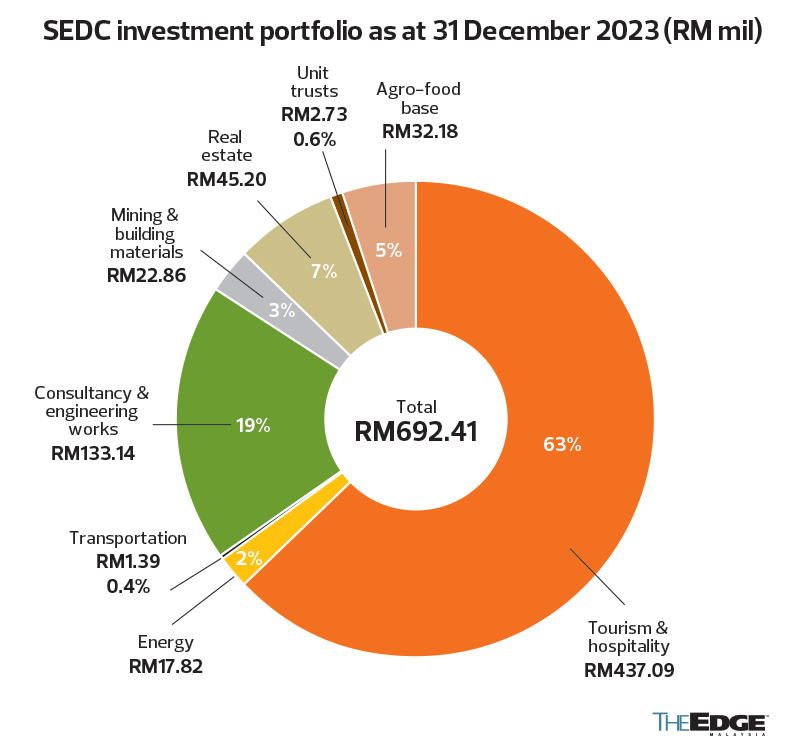
The hospitality and services sector still accounted for the largest portion of SEDC’s investment portfolio in 2023, at 63%, followed by the consultancy and engineering works sector. This is a stark contrast to the energy sector, which accounts for only 2%.

With a progressive shift towards high-value manufacturing and green energy, Aziz says the focus of its portfolio would only change over time.

That said, infrastructure continues to play an important role in SEDC’s development strategy.

“[Investments in] infrastructure will still be there, as we need to develop the state. Our investment in Innocement Sdn Bhd, for example, is important to stabilise cement prices.

“We have small shares in CMS (Cahya Mata Sarawak) and KKB (Engineering Bhd) and other [companies, and] will remain [invested as] those are investments for us to get returns,” Aziz says.

Overall, the asset value of SEDC and its 35 subsidiaries stood at RM2.96 billion at end-2023 (from RM830.34 million in 2020), with reserves standing at RM791 million.

Aziz says SEDC also has its eye on other sectors such as electrical vehicles (EVs) and pharmaceuticals, having established a medical glove manufacturing plant at its Sarawak Medical Innovation Technology Hub.

“To develop EVs, we need batteries. The basic materials are sodium and graphite. So, SEDC has recently tied up with Gallois (New Energy Materials (M) Sdn Bhd) to produce graphite in Sarawak.

“By having a joint venture with Petronas’ (Petroliam Nasional Bhd’s clean energy outfit) Gentari, we can later use this technology to produce fuel cells. With the fuel cells and batteries, we can develop our own EV industry,” says Aziz.

Apart from commercial profitability, SEDC is also tasked with taking on socially beneficial projects.

One example is Sarawak Metro Sdn Bhd, a wholly-owned subsidiary of SEDC set up to develop the Kuching Urban Transportation System, a project not expected to be profitable in itself but considered vital for the development of the state’s economy.

While the government fully funds the capital expenditure of such projects, SEDC handles the operational costs, reiterating its commitment to corporate social responsibility. The corporation is also focusing on food sufficiency as plans are in place to increase protein production essential for childhood development, thereby enhancing public nutrition, Aziz explains.

As SEDC strides towards achieving its ambitious targets, it acknowledges potential challenges. While Sarawak’s gross national income per capita exceeded the World Bank’s US$13,205 (RM62,500) high-income threshold in 2023, Aziz says the state is more concerned about wealth distribution.

“We can get there in terms of GDP [per capita]. The bigger challenge will be the distribution of wealth, raising everyone’s income to RM15,000 per month by 2030. We want higher-paying jobs; we need higher-value products. We are in a hurry to get there.”

Source: The Edge Malaysia

SEDC to use high-value industries to power Sarawak’s new economy


Content Type:

Duration:

New investment interests arising from the roundtable and one-on-one meetings with Prime Minister Datuk Seri Anwar Ibrahim here today are worth a potential RM45.4 billion.

Investment, Trade and Industry Minister Tengku Datuk Seri Zafrul Abdul Aziz said the potential investments encompassed new as well as expansion and diversification projects.

“The potential investments are from various industries such as semiconductor, aerospace, medical devices, chemicals and services,” he told Malaysian journalists after the roundtable and one-on-one meetings with Anwar.

A total of 38 captains of industry and businesses from German cities like Stuttgart, Munich, Berlin, and Frankfurt, as well as from Belgium and France, joined the meetings.

Anwar also had one-on-one meetings with officials from X-Fab, Melexis, Infineon Technologies AG, Schott AG, and Airbus.

The Prime Minister, who arrived here on Sunday, took the opportunity to assure German businesses that Malaysia remains one of the best and preferred locations for investors with business-friendly approaches.

The companies from the world’s biggest economies that came to see the premier are involved in sectors like energy, medical devices, semiconductors, electronics, machinery, automotive, and aerospace.

Tengku Zafrul said through the engagements with the companies, there are strong indications that German companies are positive and remain committed to Malaysia as their investment destination.

X-Fab, Melexis, and Schott to commence operations soon

According to the minister, X-Fab, Melexis, and Schott gave updates that their projects, with approved investments amounting to RM4.45 billion, are currently under construction and are expected to commence operations within this year.

During the one-on-one meeting with the prime minister, the chief operating officer of Infineon, Rutger Wijburg, said the company was on track to build the world’s largest 200-millimetre SiC (silicon carbide) power fab in Kulim. “Infineon and Malaysia building the world’s biggest SiC factory. Together, Malaysia and Infineon are fighting climate change,” he said.

Infineon, which has been operating in Malaysia since 1973, announced last year that over the next five years, the company will additionally invest up to five billion euros in Kulim during a second construction phase for its Module Three plan. The investment will lead to an annual SiC revenue potential of about seven billion euros by the end of the decade, together with the planned 200-millimetre SiC conversion in Villach and Kulim.

Among those who attended today’s meetings with Anwar were Siemens AG group chief executive officer (CEO) Roland Busch, B. Braun GmbH CEO Anna Braun, and Melexis CEO Marc Biron. Also present were Airbus Asia Pacific president Anand Stanley and Volkswagen Group Malaysia managing director Susanne Lehmann.

Representatives from the German Chamber of Commerce, the Malaysia-German Chamber of Commerce, and the German Association for Small and Medium-sized Enterprises (BVMW) were also there.

Also present during the meeting were Foreign Minister Datuk Seri Mohamad Hasan, Malaysian Investment Development Authority (MIDA) CEO Datuk Wira Arham Abdul Rahman, and Malaysia External Trade Development Corporation (MATRADE) CEO Datuk Mohd Mustafa Abdul Aziz.

There are over 700 German companies based in Malaysia, with 65,000 jobs created.

Germany has been Malaysia’s largest trading partner among European Union member countries since 2000, while Malaysia is the largest trading partner for Germany among Asean member states.

In 2023, Malaysia’s total trade with Germany increased by 5.9 per cent to RM63.45 billion (US$13.90 billion) from RM59.87 billion (US$13.62 billion) in 2022. 

Source: Bernama

New potential investments worth RM45.4b from Germany, says Tengku Zafrul


Content Type:

Duration:

The Ministry of Investment, Trade and Industry (MITI) is aiming for Malaysia to have 100 local technology companies with annual revenue of RM1 billion by 2030, according to Deputy Minister Liew Chin Tong.

He said the government will continue to support local companies in research and development (R&D) and innovation by providing assistance to small and medium enterprises (SMEs) nationwide.

“Various types of assistance are being provided by MITI and its agencies including financing assistance, advisory services and business guidance to strengthen the SME value chain,” he said in winding up the debate on the Motion of Thanks for the Royal Address in the Dewan Rakyat today.

He was responding to Datuk Seri Amirudin Shari’s (PH-Gombak) proposals to enhance collaborations among states and expand the market especially for SMEs by building a national innovation system.

Liew said that MITI, through the Malaysian Investment Development Authority, is spearheading efforts to boost collaborations among Selangor, Kuala Lumpur, Melaka and Negeri Sembilan.

The effort is aimed at developing joint industrial clusters, including for the aerospace industry and global services hub.

Meanwhile, answering a query from Wan Ahmad Fayhsal Wan Ahmad Kamal (PN-Machang) who asked about MITI’s direction in increasing strategic investments, Liew said the government will ensure that investments coming into the country comply with 12 revenue-based indicators that will be used to gauge investment quality under the New Industrial Master Plan 2030 and National Investment Aspirations.

Among the 12 indicators are strengthening efforts in high value-added activities, accelerating regional R&D activities, and creating high-skilled job opportunities.

Source: Bernama

MITI aims to have 100 local tech companies with RM1bil revenue by 2030


Content Type:

Duration:

Sweden is keen on collaborating with Malaysia, given the substantial potential for growth and cooperation in sustainable practices to bolster sustainable initiatives and foster a green transition.

Swedish ambassador to Malaysia, Dr Joachim Bergstrom said that Swedish companies in Malaysia have been actively engaging with local stakeholders to drive sustainable agendas, focusing on sectors such as green manufacturing, transportation, mobility and energy transition.

“I think that we will potentially see increased trade within the energy transition area, where companies can supply storage and transmission facilities for biofuels and waste energy.

“In many ways, Sweden and Malaysia are very like-minded. We are both small countries with a long history and tradition in trading, besides being neutral and non-aligned,” he told Bernama.

Bergstrom noted that recent discourse between the two nations has centred around developing joint efforts to combat climate change and promote sustainable practices.

“Notably, the ‘Pioneer the Possible’ initiative serves as a platform to facilitate collaboration and raise awareness regarding sustainability goals,” he added.

Launched in 2023, the platform aims to boost green transition in Malaysia through collaboration between Swedish companies such as Volvo Trucks and Atlas Copco as well as local stakeholders, said Trade Commissioner of Sweden to Malaysia, Emma Broms.

“The Malaysian Green Technology and Climate Change and Business Sweden had inked a memorandum of understanding, and there is also the collaboration with the Federation of Malaysian Manufacturers, other local stakeholders and ministries within this programme,” she said.

There are currently over 80 active Swedish companies based in Malaysia, with close to 9,000 employees working with local counterparts to increase access to green energy.

Broms emphasised Malaysia’s potential to become a crucial partner in Asean-European Union bilateral trade and economic strengthening.

“Digitalisation is one of the areas where we will see a lot of development going forward. Ericsson is currently rolling out the 5G network in Malaysia, paving the way for other companies providing solutions,” she said.

She added that Sweden also has much to offer in terms of cybersecurity, which would become increasingly important going forward.

“We also see numerous developments in the healthcare area as there is a growing demand for medical devices and digital e-health solutions,” she said.

Broms also noted that a new production facility for electrically-powered mining vehicles is being constructed by Swedish company, Sandvik, in Sendayan TechValley business park, near Seremban.

“There is already a lot of development happening, with Swedish investments into Malaysia amounting to US$500 million, making Malaysia one of the largest receivers of Swedish investment,” she added.

Source: Bernama

Sweden keen to forge green partnership with Malaysia: Ambassador


Content Type:

Duration:

wpChatIcon