

|


|

This site
is mobile
responsive
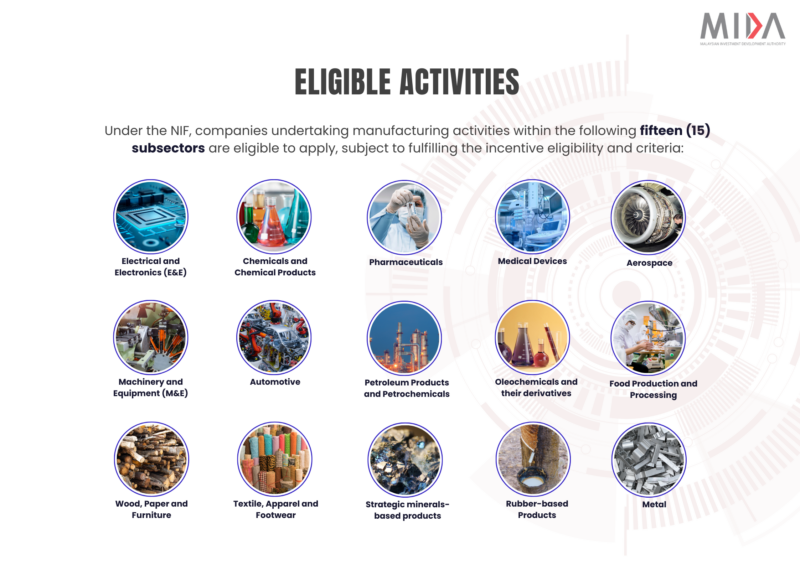
As Malaysia strengthens its position as a preferred investment destination, the New Incentive Framework (NIF) marks a significant shift towards attracting quality investments that generate long-term economic value, stronger industrial capabilities and better jobs.
Malaysia’s investment landscape is entering a new phase. Rapid technological advancement, evolving global tax rules, shifting geopolitical dynamics and the global transition towards sustainability are reshaping how countries compete for investments. To remain competitive, the Government has introduced the NIF, a modern incentive system designed to attract high-quality, high-impact investments.
The NIF represents a significant shift from traditional profit-based tax incentives to an outcome-based incentive approach. This newly reformed incentive is intended to deliver a true “win-win” for both the Malaysian economy and investors. For Malaysia, it fuels a high-value economic transformation centred on technology, innovation and deeper economic spillovers. For investors, the framework offers greater transparency and predictability through clearly defined assessment criteria linked to measurable outcomes. It also positions Malaysia to remain aligned with evolving international standards, including the OECD’s Pillar II Global Minimum Tax.
Global investment priorities have evolved beyond cost competitiveness. Today, investors increasingly consider technological capability, supply chain resilience, skilled talent, sustainability and geopolitical stability when choosing investment locations.
The framework also supports industrial ambitions under the National Investment Aspirations (NIA) and the New Industrial Master Plan (NIMP) 2030.
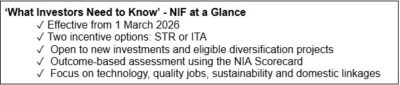
The NIF came into effect on 1 March 2026 for the manufacturing sector. Under the NIF, investors may choose one of the two mutually exclusive incentive options based on their investment profile:
Special Tax Rate (STR)
Investment Tax Allowance (ITA)
The initial phase of the NIF introduces these incentive options to encourage new investments.
Importantly, the NIF is not confined to new investors. Existing companies undertaking diversification activities, including investments for new product lines, may also be eligible for incentives.
Projects are assessed based on their potential contribution to Malaysia’s national development priorities. These include economic complexity, high-value job creation, domestic supply chain linkages, industrial cluster development, inclusivity, and sustainability. Projects with stronger commitments to advanced technology, innovation, talent development, domestic participation, and workforce enhancement may be eligible for higher-tier incentives.

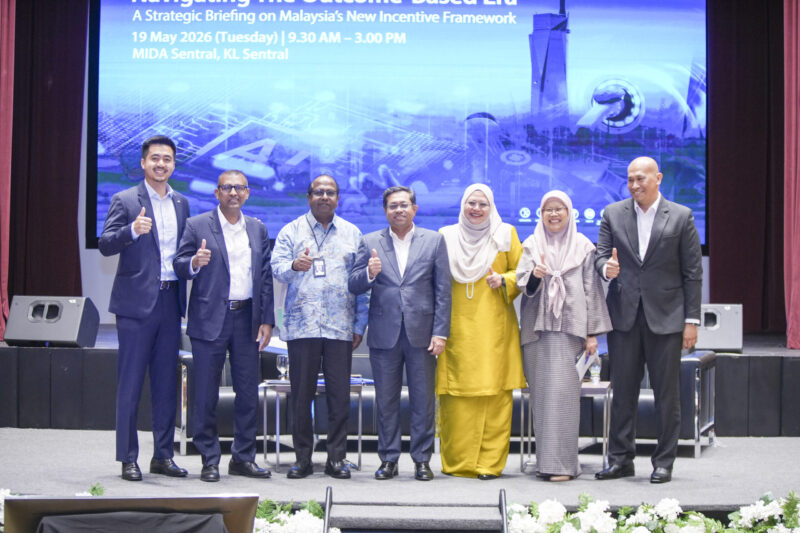
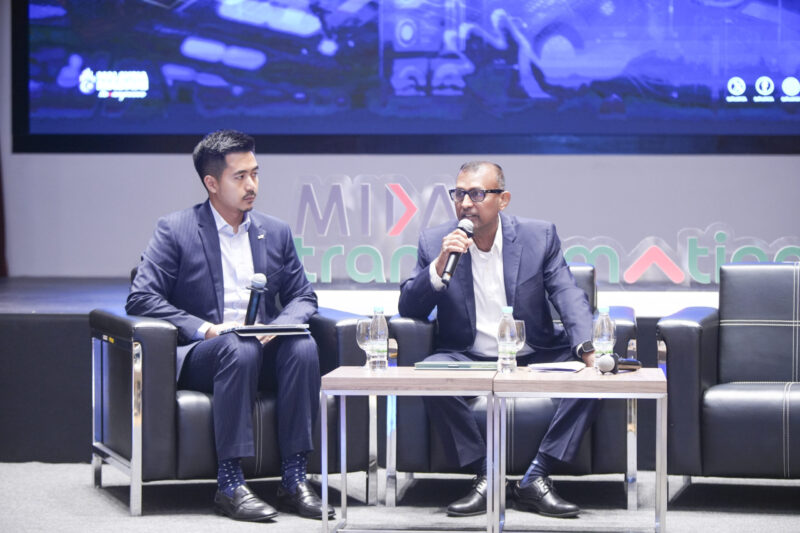
Following the launch of the NIF for the manufacturing sector, MIDA organised its inaugural strategic briefing, “Tax Reforms: Navigating the Outcome-Based Era – A Strategic Briefing on Malaysia’s New Incentive Framework (NIF)” on 19 May 2026. The event was officiated by Ms. Zalina Zainol, Deputy Chief Executive Officer, Investment Promotion and Facilitation, who highlighted the importance of the NIF in supporting Malaysia’s transition towards a transparent, predictable and performance-based incentive framework.
The briefing attracted nearly 80 participants, including industry players, investors, tax practitioners, financial professionals, academics and government agencies, providing stakeholders with greater clarity on the framework and its implementation.
Programme highlights included:
A key takeaway from the session was the importance of early engagement and pre-application consultation. Investors were encouraged to assess their projects against the NIA Scorecard to better understand their eligibility and align their investment proposals with Malaysia’s national development priorities.
The event also provided a valuable platform for direct engagement between MIDA and the business community through presentations, interactive discussions and one-on-one consultations. Participants gained practical guidance on eligibility requirements, assessment criteria, incentive options and the InvestMalaysia digital platform. Existing investors were assured that projects with previously approved incentives will continue under their original terms and conditions, reinforcing Malaysia’s commitment to policy certainty and investor confidence.
The strong participation and active discussions reflected the industry’s readiness to embrace Malaysia’s new outcome-based incentive framework. The briefing marked an important milestone in helping investors understand the NIF and prepare for the next phase of Malaysia’s industrial transformation.
For more information on the NIF, please visit https://www.mida.gov.my/media-release/new-incentive-framework-nif/
Explore other related content to further
explore MIDA’s insights.