

|


|

This site
is mobile
responsive
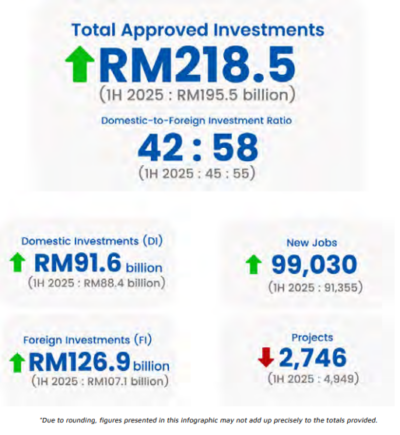
Malaysia’s RM218.5 billion in approved investments across the services, manufacturing and primary sectors tells only part of the story. Beyond the headline figure, the latest performance reflects important shifts in the country’s investment landscape, from the expansion of digital infrastructure and higher-value manufacturing to stronger domestic participation and the creation of more skilled jobs. Approved investments increased by 11.7 per cent year-on-year, involving 2,746 approved projects expected to create 99,030 new jobs.
Foreign investments contributed RM126.9 billion, while domestic investments accounted for RM91.6 billion. This combination reflects continued international confidence in Malaysia, alongside the growing participation of Malaysian companies in the country’s development.
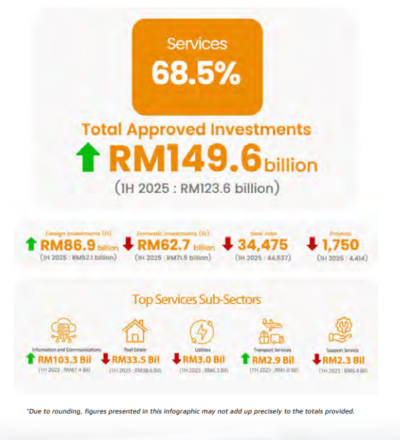
The services sector remained the largest contributor, accounting for RM149.6 billion or 68.5 per cent of total approved investments. Its strong performance was largely driven by the continued expansion of Malaysia’s digital economy.
Information and communications technology (ICT) attracted RM103.3 billion, of which RM95.8 billion came from data centre and cloud-related investments. These investments are strengthening Malaysia’s role as a regional digital infrastructure hub. Beyond digital infrastructure, services investments also attracted real estate, utilities, transport and support services, creating opportunities across Malaysia’s broader services economy.
As Malaysia continues to position itself as an AI nation by 2030, the focus is increasingly on ensuring that digital investments generate wider economic opportunities. The Data Centre Task Force, for instance, gives priority to projects with secured power and water supply, demonstrable green compliance and stronger local supply chain participation.
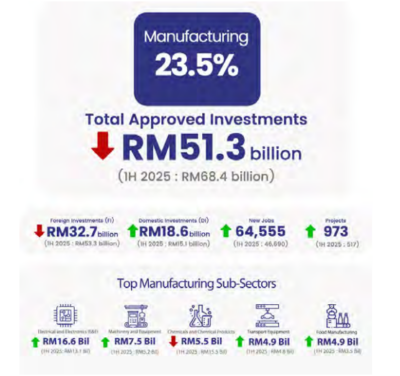
Manufacturing contributed RM51.3 billion in approved investments across 973 projects. While the total value was affected by several large-scale projects approved in the exceptionally strong first half of 2025, the number of manufacturing projects increased significantly by 88.2 per cent.
Notably, the value of new manufacturing projects more than doubled to RM25.8 billion, rising 112.2 per cent year-on-year. Domestic investment in manufacturing also grew by 23 per cent to RM18.6 billion, reflecting stronger participation by Malaysian companies.
The sector is increasingly moving beyond traditional manufacturing activities towards higher-value capabilities. Electrical and electronics (E&E) led manufacturing investments with RM16.6 billion, followed by machinery and equipment at RM7.5 billion, chemicals at RM5.5 billion, transport equipment at RM4.9 billion and food manufacturing at RM4.9 billion.
Together, these five industries accounted for more than three-quarters of total manufacturing approvals. Nearly one-third of approved manufacturing projects also plan to export at least 80 per cent of their output, reinforcing Malaysia’s continued role as a production and export base for global markets.
The employment profile is also becoming more skills-intensive. Manufacturing projects are expected to create 64,555 jobs, including local Managerial, Technical and Supervisory (MTS) positions. Nearly one in five local manufacturing jobs is expected to offer monthly salaries of RM5,000 or more, pointing to the growing demand for higher-skilled talent.

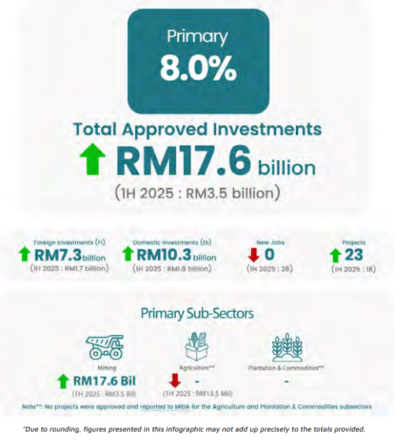
The primary sector recorded the strongest year-on-year growth, with approved investments rising 414 per cent to RM17.6 billion, driven by 23 offshore oil and gas projects.
Domestic investment accounted for RM10.3 billion, or 58.5 per cent of the sector, demonstrating the growing capacity of Malaysian companies to undertake larger upstream projects. Sarawak and Sabah accounted for the largest shares of primary sector investments.
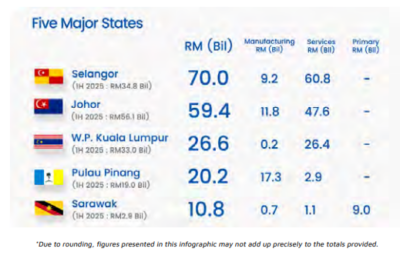
Across Malaysia, Selangor, Johor, W.P. Kuala Lumpur, Pulau Pinang and Sarawak recorded the highest levels of approved investments, reflecting the diverse strengths and investment proposition offered by different parts of the country.
For Malaysia, the significance of these investments extends beyond the value of approvals. The focus is increasingly on how investments translate into new production capacity, technology, skilled employment and opportunities for local businesses.
This is reflected in the implementation progress of approved manufacturing projects. As of 18 August 2026, 87 per cent of the 5,822 manufacturing projects approved between 2021 and June 2026 had reached various stages of implementation, from construction through to production. More than 90 per cent of projects approved between 2021 and 2024 had been implemented.
MIDA continues to support this transition from approval to implementation through the Invest Malaysia Facilitation Centre (IMFC) and close coordination with ministries and agencies to address regulatory and implementation matters. Through initiatives such as #InvestLokal, MIDA is also working to strengthen linkages between investors and Malaysian SMEs and local vendors.
Malaysia’s investment pipeline also remains encouraging. As of 10 August 2026, MIDA was reviewing 227 proposals worth RM72.1 billion, alongside a further RM58.4 billion in high-potential investment leads. These opportunities are concentrated in strategic areas including semiconductors, AI infrastructure, renewable energy and medical devices.
The first half of 2026 therefore points to more than continued investment momentum. It reflects Malaysia’s ongoing transition towards investments that strengthen industrial capabilities, deepen domestic participation and create higher-value opportunities for Malaysians.
Read the full MIDA media release: https://www.mida.gov.my/media-release/malaysia-secures-rm218-5-billion-in-approved-investments-in-1h-2026-with-domestic-investment-in-manufacturing-up-23/

Explore other related content to further
explore MIDA’s insights.