

|


|

This site
is mobile
responsive
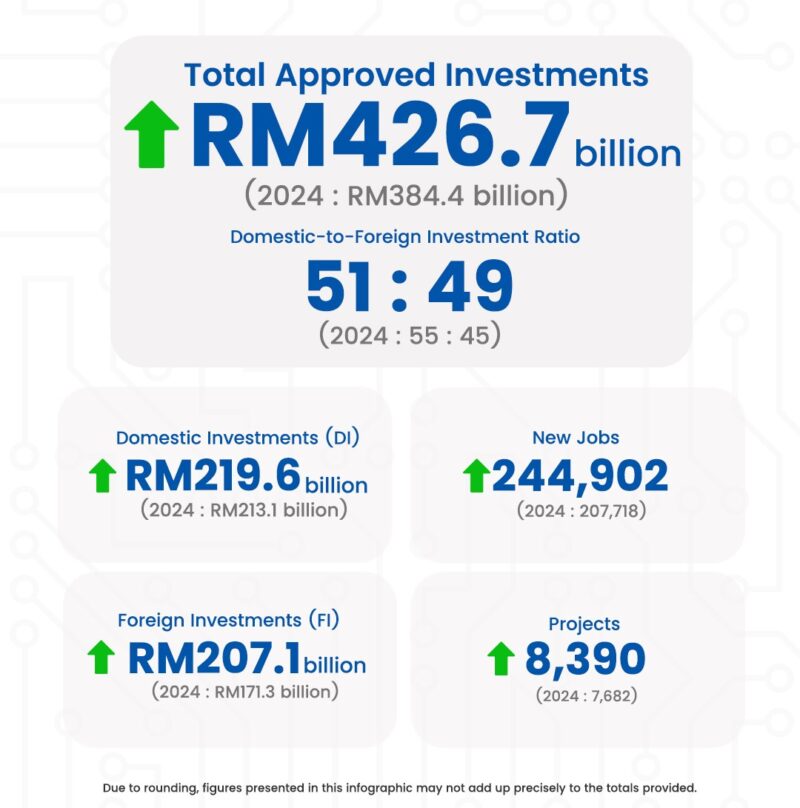
Malaysia’s investment performance reached a new milestone in 2025, with RM426.7 billion in approved investments, marking an 11.0% year-on-year increase and the highest level ever recorded.
Malaysia’s investment landscape in 2025 reflects a balanced and resilient composition, with domestic investments contributing RM219.6 billion (51.5%) and foreign investments rising 20.9% to RM207.1 billion (48.5%).
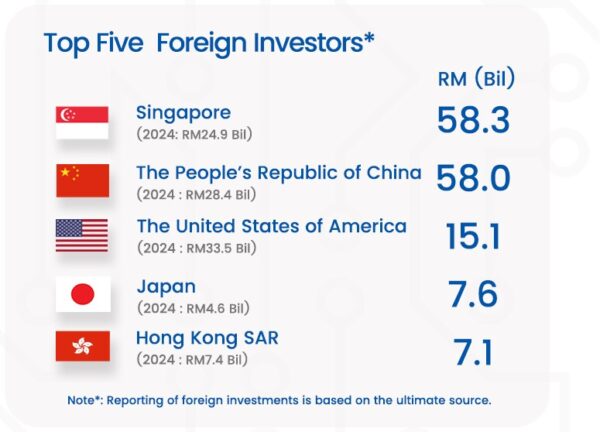
Key sources of foreign investment included Singapore, China, the United States, Japan, and Hong Kong, highlighting Malaysia’s continued appeal as a strategic gateway within ASEAN and the broader Asia-Pacific region.
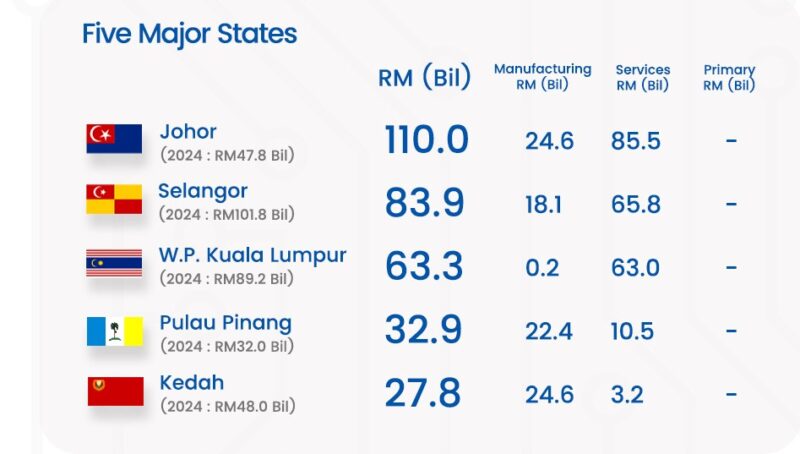
At the state level, Johor, Selangor, Kuala Lumpur, Pulau Pinang, and Kedah collectively accounted for 74.5% of total approved investments, further reinforcing the strength of Malaysia’s industrial and economic corridors.
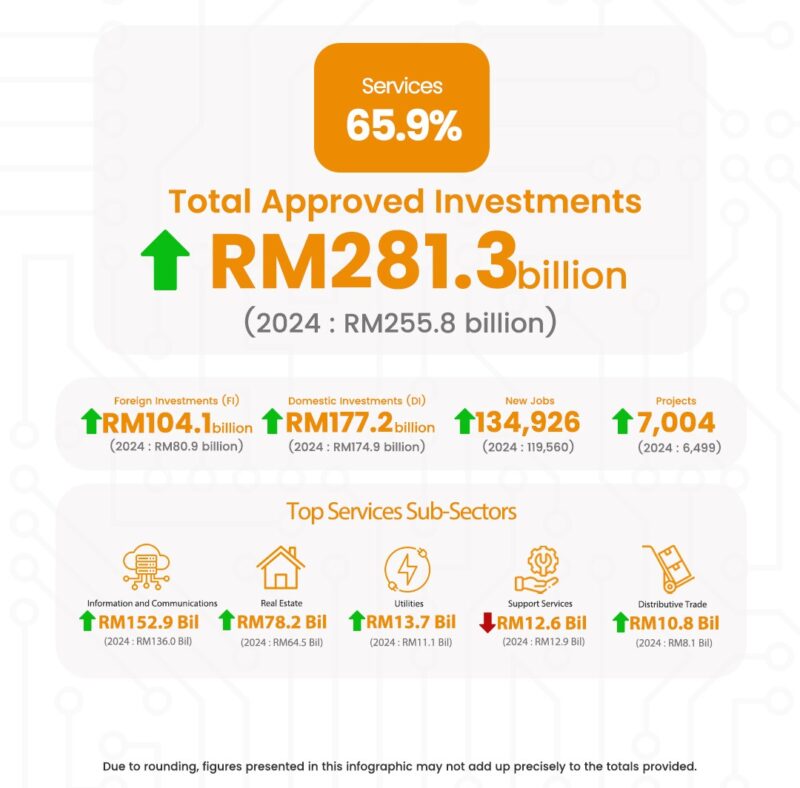
The services sector remained the primary engine of growth, contributing RM281.3 billion or 65.9% of total approved investments.
At the forefront of services growth is the information and communications sub-sector, which recorded RM152.9 billion in approved investments driven by AI, data centres, big data, and cloud computing. UNCTAD data shows that data centres attracted more than one-fifth of all global greenfield project value in 2025, with Malaysia explicitly named among the key emerging destinations for such investments at scale. Malaysia’s approach ensures this digital expansion serves a broader purpose: accelerating the energy transition, raising the quality of employment, and deepening local ecosystem development.

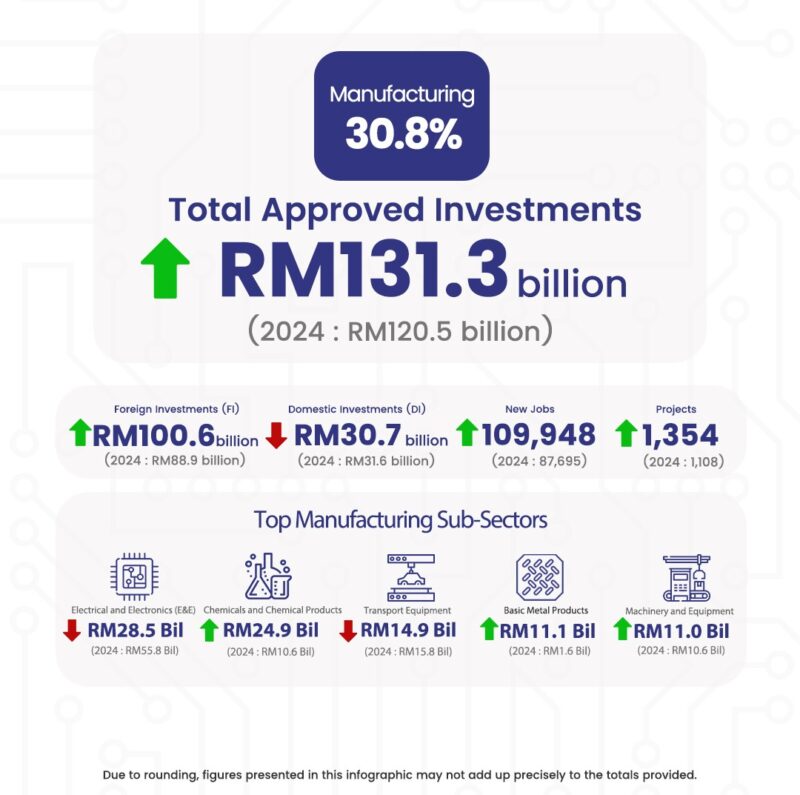
The manufacturing sector recorded RM131.3 billion in approved investments, accounting for 30.8% of total approvals.
More importantly, the sector continues to shift toward high-value, technology-intensive activities, supported by strong foreign participation and deeper integration into global supply chains.
This transformation is reflected in job creation trends, with a significant share of new roles concentrated in managerial, technical, and supervisory (MTS) positions, signalling Malaysia’s transition towards a more skilled and innovation-driven industrial base.
Key industries driving this growth include electrical and electronics (E&E), chemicals, transport equipment, and machinery and equipment.
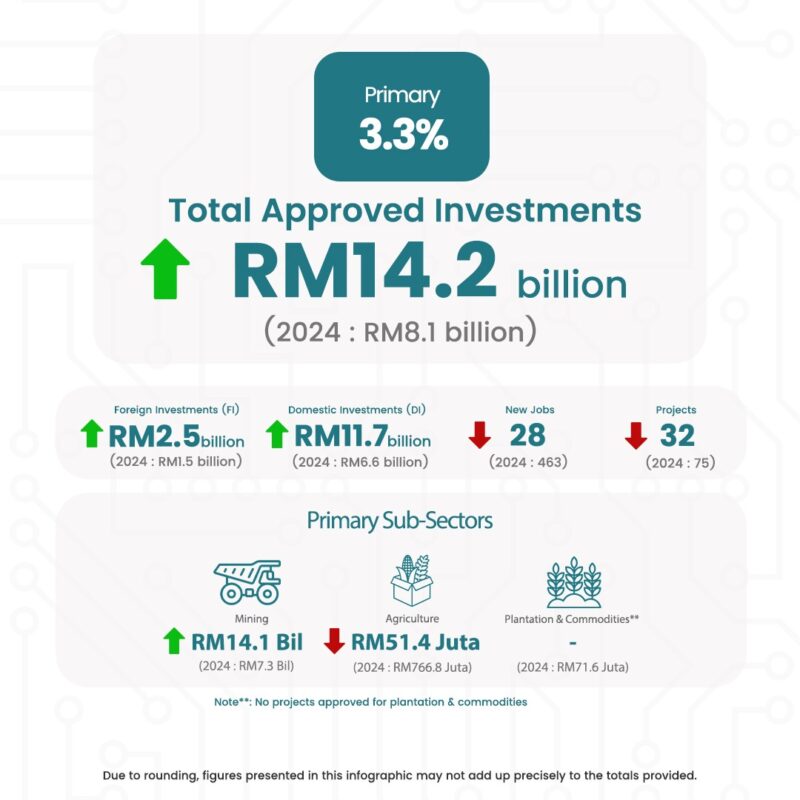
The primary sector recorded RM14.2 billion in approved investments, representing 3.3% of the total approvals. Across 32 projects, the sector is projected to generate over 28 new jobs, with investments concentrated in mining (RM14.1 billion) and agriculture (RM51.4 million). While modest in scale, the sector reflects continued strategic interest in resource-based and upstream activities.

Malaysia’s industrial ecosystem continues to deepen through the expansion of strategic clusters, supported by forward-looking policy frameworks.
Established hubs such as Pulau Pinang’s E&E ecosystem remain globally competitive, while emerging clusters in automotive and petrochemicals, particularly in Tanjong Malim and Johor’s southern corridor, are gaining momentum.
Importantly, growth is becoming more geographically inclusive. Less developed states collectively secured RM66.0 billion in investments, supporting job creation and regional development in line with national priorities.
These developments are reinforced by national frameworks such as the MADANI Economic Framework and the New Industrial Master Plan 2030 (NIMP 2030), alongside ongoing reforms including the New Incentive Framework (NIF) and updated industrial legislation.
Together, these measures are strengthening Malaysia’s competitiveness by prioritising quality investments, ecosystem development, and long-term value creation.
Malaysia’s pipeline of projects remains robust. As at 2 February 2026, MIDA is overseeing 172 pipeline projects with proposed investments totalling RM29.1 billion.
In addition, RM65.5 billion in high-potential investment leads are currently under active negotiation by MIDA, reflecting sustained investor confidence in Malaysia’s economic fundamentals.
Malaysia’s strength lies not only in attracting investments, but in delivering them.
Between 2021 and 2025, the National Committee on Investment approved 4,848 manufacturing projects, of which 84.9% have reached various implementation stages, ranging from production to factory construction and machinery installation.
Additionally, projects approved in 2025 have recorded a 62.2% implementation rate, in line with the typical 18 to 24 months development cycle for completion, depending on project complexity.
Malaysia’s record RM426.7 billion in approved investments is more than a numerical achievement, it reflects a maturing investment ecosystem anchored in resilience, policy clarity, and execution capability.
As global investment patterns continue to evolve, Malaysia’s ability to attract, facilitate, and implement high-quality investments positions the country firmly on track to become a regional hub for innovation, advanced industries, and sustainable growth.

Explore other related content to further
explore MIDA’s insights.