

|


|

This site
is mobile
responsive
The Central Region is not merely Malaysia’s industrial heartland — it is the engine room of the nation’s next phase of industrial transformation. Comprising the Federal Territories, Selangor, Negeri Sembilan and Melaka, the region has long anchored Malaysia’s manufacturing depth, logistics connectivity and institutional capacity.
Today, it is moving beyond scale toward integration through a coordinated industrial cluster strategy designed to build a seamless and technology-driven production ecosystem.
This initiative represents a structural evolution in industrial development. Rather than treating investments as isolated projects within individual states, the cluster approach aligns capabilities across locations, supply chains and institutions. The focus is clear: strengthen linkages, enhance productivity and position the Central Region as a globally competitive hub for high-value industries.
The Central Region already hosts well-established capabilities in Electrical and Electronics (E&E), aerospace, pharmaceuticals and medical technology, as well as food manufacturing and the halal economy. These sectors are supported by dense networks of engineering services, precision tooling firms, testing laboratories, logistics providers, financial institutions and research universities.
What distinguishes the cluster development initiative is its focus on integration. Infrastructure, talent development, regulatory facilitation and supplier ecosystems are aligned to ensure industries do not operate in silos. Instead, multinational corporations, domestic champions and small and medium enterprises function within interconnected value chains that enable scale, innovation and resilience. This transition from industrial presence to ecosystem advantage allows companies to move faster, reduce operational friction and embed more deeply within Malaysia’s manufacturing landscape.
Clustering is reinforced by geographical proximity and complementary specialisation. The KLIA–Subang–Serendah corridor for instance, exemplifies how coordinated development can accelerate productivity. Within a compact radius, aerospace maintenance, repair and overhaul (MRO), advanced manufacturing, precision engineering and technical training facilities operate in close alignment.
Such spatial concentration shortens supply chains, reduces logistics risks and facilitates rapid knowledge transfer. When suppliers, manufacturers and research institutions are located within accessible distance, innovation cycles accelerate and collaboration becomes more organic.
This model demonstrates how physical connectivity and industrial coordination combine to create efficiency gains that extend beyond individual firms— strengthening the competitiveness of the entire ecosystem.
The Central Region industrial cluster strategy is aligned with Malaysia’s broader transformation agenda under the New Industrial Master Plan 2030 (NIMP 2030), alongside complementary national frameworks focused on semiconductor advancement and green investment.
Alignment with these national priorities ensures coherence in infrastructure planning, investment facilitation, technology adoption and sustainability standards. Federal and state initiatives are structured to complement one another, enabling coordinated execution rather than fragmented development.
This policy consistency provides investors with clarity and predictability — essential foundations for long-term capital commitments in advanced manufacturing and high-technology sectors.
A defining feature of the ecosystem-driven approach is the deliberate strengthening of domestic supply chains. Industrial clusters create structured pathways for local enterprises to integrate into higher-value segments of global production networks, particularly in specialised engineering, machinery, tooling, maintenance services and digital-enabled processes.
Through coordinated engagement between industry, academia and technical institutions, capabilities are continuously upgraded to meet evolving global standards. This ensures that local suppliers remain competitive in areas requiring precision, speed and advanced technological integration.
The emphasis on ecosystem certainty — encompassing reliable infrastructure, regulatory clarity, skilled talent and supplier depth — enhances investor confidence while supporting upward mobility for the domestic workforce.
Effective cluster development depends not only on infrastructure, but on institutional coordination. The Central Region benefits from strong collaboration between federal and state governments, industrial park operators, logistics providers, universities and industry associations.
As Malaysia’s principal investment promotion agency, MIDA assumes a central facilitative role in connecting investors with local ecosystems. Engagement between foreign and domestic firms is actively supported, while ecosystem gaps are identified and addressed through targeted initiatives. This reflects a broader shift in industrial development — from approving individual projects to cultivating interconnected industrial systems capable of sustaining innovation and long-term competitiveness.
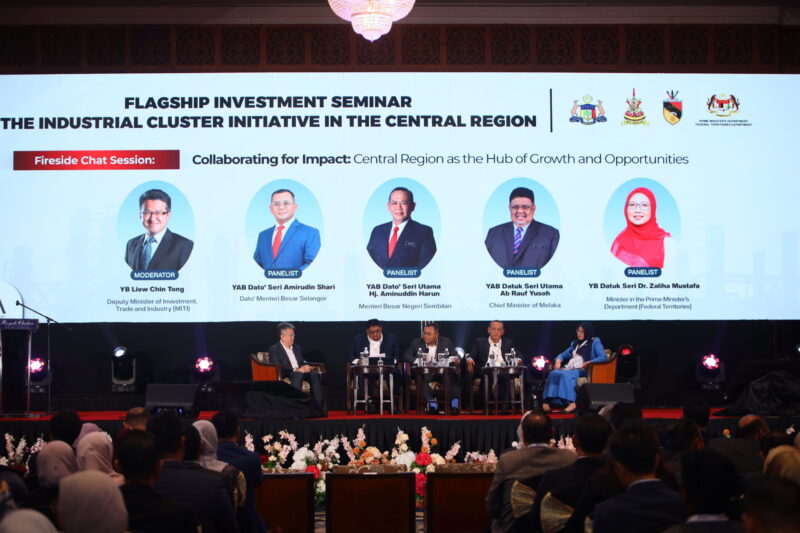
As global supply chains become more complex and technology cycles accelerate, competitive advantage increasingly depends on ecosystem depth rather than standalone capacity. The Central Region’s industrial cluster initiative recognises this reality by embedding collaboration, specialisation and sustainability into its development model.
By integrating advanced manufacturing, digital infrastructure, engineering services and institutional partnerships, the region is positioning itself as truly a seamless production ecosystem — one that supports innovation, attracts high-quality investment and enables enterprises to scale with resilience.
Through coordinated execution and sustained partnership, the Central Region reinforces Malaysia’s ambition to move up global value chains while ensuring industrial growth remains inclusive, future-ready and strategically aligned with national priorities.
Discover investment opportunities in the Central Region. Connect with MIDA’s Domestic Investment Division at https://www.mida.gov.my/staffdirectory/domestic-investment-division/ to explore how your business can be part of Malaysia’s integrated industrial ecosystem.
Explore other related content to further
explore MIDA’s insights.